Week 8CHAPTER 08
Capital Structure
The financing decision: whether a company should raise debt, equity, or a hybrid, and at what cost. Why capital structure is a founder's highest-stakes financial choice; how Modigliani and Miller set the frictionless baseline and then break it with taxes; the tradeoff theory that balances the interest tax shield against distress; the pecking order under asymmetric information; the agency-cost and signaling forces that shape the choice; the weighted average cost of capital and why a startup's cost of equity is dilution; the debt instruments available to startups and the tax-shield caveat; how the capital stack evolves across the lifecycle; when venture debt extends runway and when it becomes a cliff; and the control, signaling, and rich-versus-king dimensions beyond money, with four interactive calculators.
~120 min8 sections50 questions4 tools
Learning objectives (9)
Learning Objectives
By the end of this chapter you should be able to:
- 1Explain why the capital structure decision, the mix of debt, equity, and hybrid securities, is a founder's highest-stakes financial choice, setting ownership, control, and cash obligations at each round.
- 2Describe the debt-to-equity spectrum and why equity is the costliest capital even though no cash leaves the company.
- 3State and apply Modigliani-Miller Proposition I and II in a frictionless world, and show how the 1963 tax correction makes the interest tax shield add value equal to Tc times debt.
- 4Use the tradeoff theory to locate an interior optimal leverage that balances the marginal tax shield against the marginal cost of financial distress.
- 5Explain the pecking order theory and how information asymmetry and adverse selection drive the preference for internal funds, then debt, then equity, and why startups typically must invert that order.
- 6Analyze how agency costs and signaling shape the financing decision, including asset substitution, free-cash-flow discipline, and debt as a credible signal.
- 7Compute the weighted average cost of capital from its components, and reframe a startup's cost of equity as the permanent ownership it surrenders.
- 8Evaluate the debt instruments available to startups and the tax-shield caveat, and explain what the empirical evidence shows about how new firms actually finance themselves.
- 9Assess how the capital stack evolves across the lifecycle, when venture debt extends runway versus becoming a cliff, and the control, signaling, and rich-versus-king dimensions beyond money.
Part One: The Capital Structure Decision Is a Founder's Highest-Stakes Financial Choice. Section 1 of 8.
Part One · The Capital Structure Decision Is a Founder's Highest-Stakes Financial Choice
The Capital Structure Decision Is a Founder's Highest-Stakes Financial Choice
Part One
The Capital Structure Decision Is a Founder's Highest-Stakes Financial Choice
Capital structure is the mix of debt, equity, and hybrid securities a company uses to finance itself. For a founder it is the highest-stakes financial decision, because it sets who owns the company, who controls it, and how much cash the company parts with to survive.
The Highest-Stakes Financial Choice
Capital structure is the mix of debt, equity, and hybrid securities a company uses to finance itself. For a founder it is the highest-stakes financial decision, because it sets who owns the company, who controls it, and how much cash the company parts with to survive. The choice is not made once. It is made again at every round, and the effects compound.
Every financing source sits on a spectrum from pure debt to pure equity.
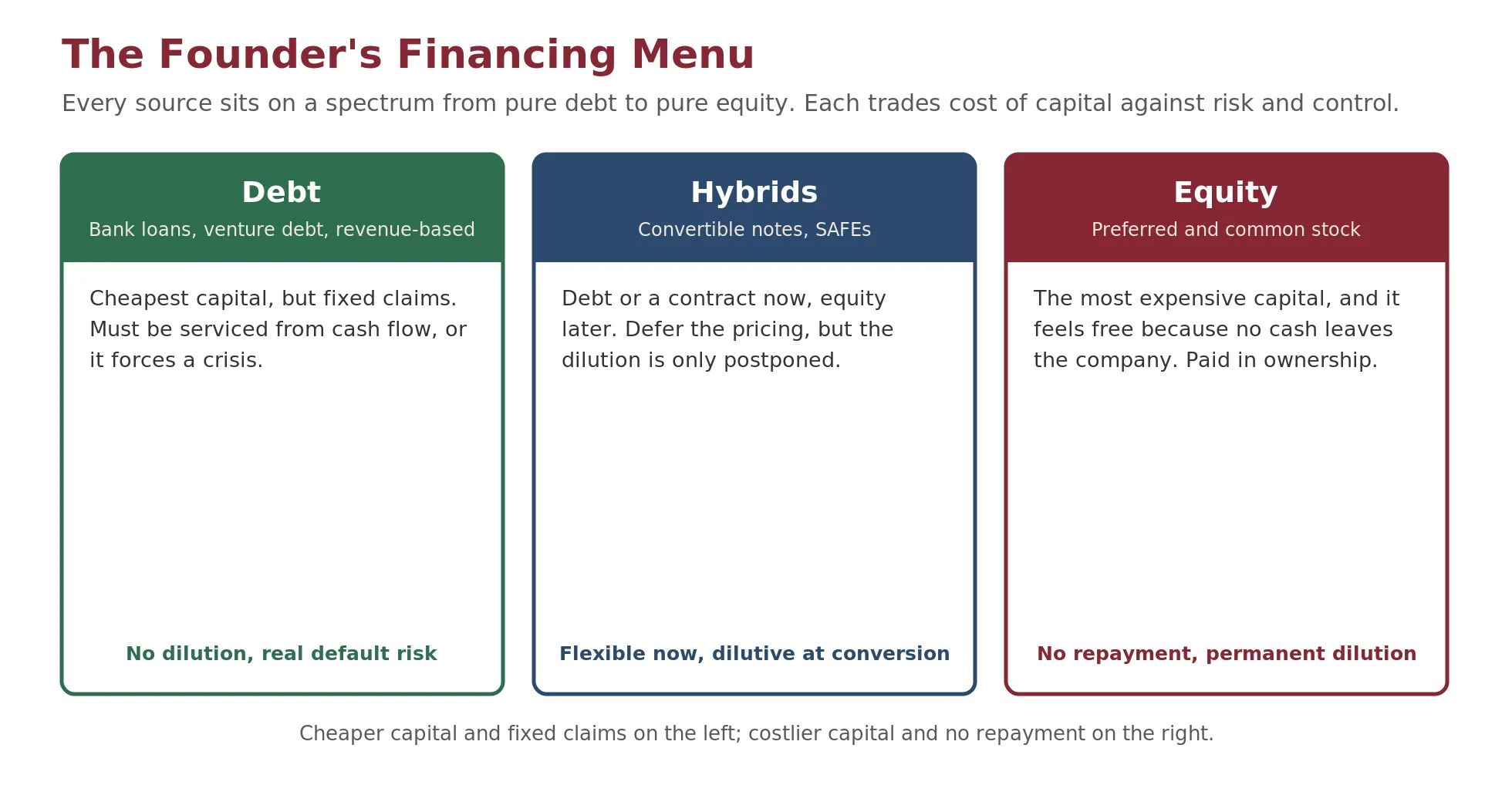
Debt is a fixed claim. It must be serviced from cash flow on a schedule, whatever the company's fortunes, and it is senior to equity in a liquidation. It is the cheapest capital, because the lender's return is capped and its claim is protected. Equity is a residual claim. It is paid last, carries no repayment obligation, and is the most expensive capital, because it is paid in permanent ownership of all future value. Hybrids, the convertible notes and SAFEs, sit between the two: debt or a contract now, equity later, deferring the pricing but only postponing the dilution.
The Central Question of This Module
The central question of this module is which of these a company should use, in what order, and at what cost. The classical theory answers that question for a mature, profitable firm. Much of the interest, and the irony, lies in how those answers change, and sometimes invert, for a startup.
Check Your Understanding
Knowledge Check 1
Capital Structure & Venture Debt
Why is equity often called the most expensive form of capital, even though no cash leaves the company?
Part Two
Modigliani and Miller: the Baseline and the Tax Correction
Modern capital structure theory begins with Modigliani and Miller: a frictionless baseline in which financing is irrelevant, and the 1963 correction in which corporate taxes make debt add value. This part builds Proposition I, Proposition II, and the interest tax shield.
Modigliani and Miller Set the Baseline, Then Break It
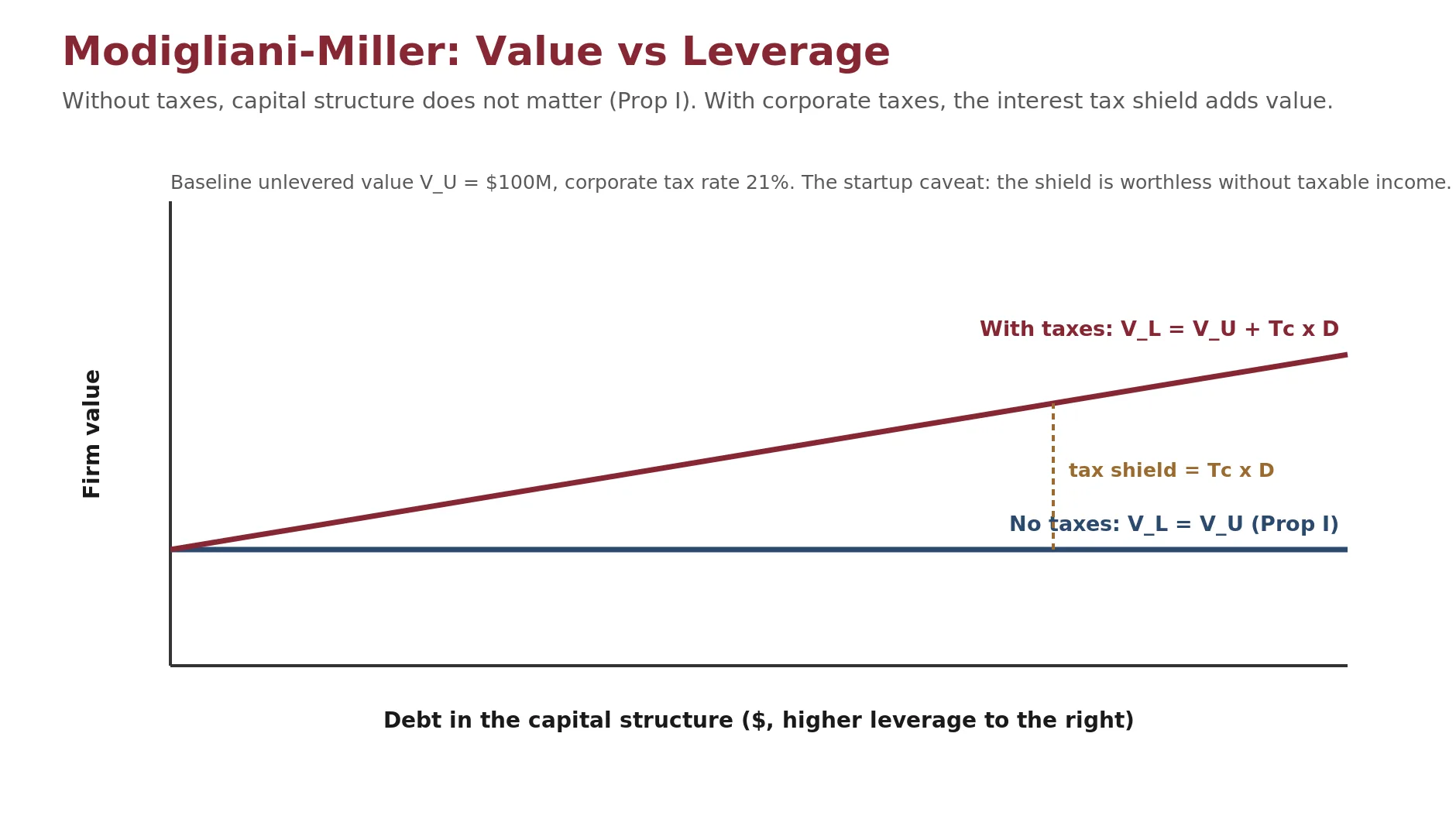
Modern capital structure theory begins with a result that seems to say the decision does not matter. Modigliani and Miller (1958) proved that in a world without taxes, bankruptcy costs, or information asymmetry, the value of a firm is independent of how it is financed. Debt and equity are interchangeable, and only the underlying cash flows matter. This is Proposition I, and its power is not that it describes reality but that it isolates exactly which frictions make capital structure matter.
Proposition II: Leverage Raises the Cost of Equity
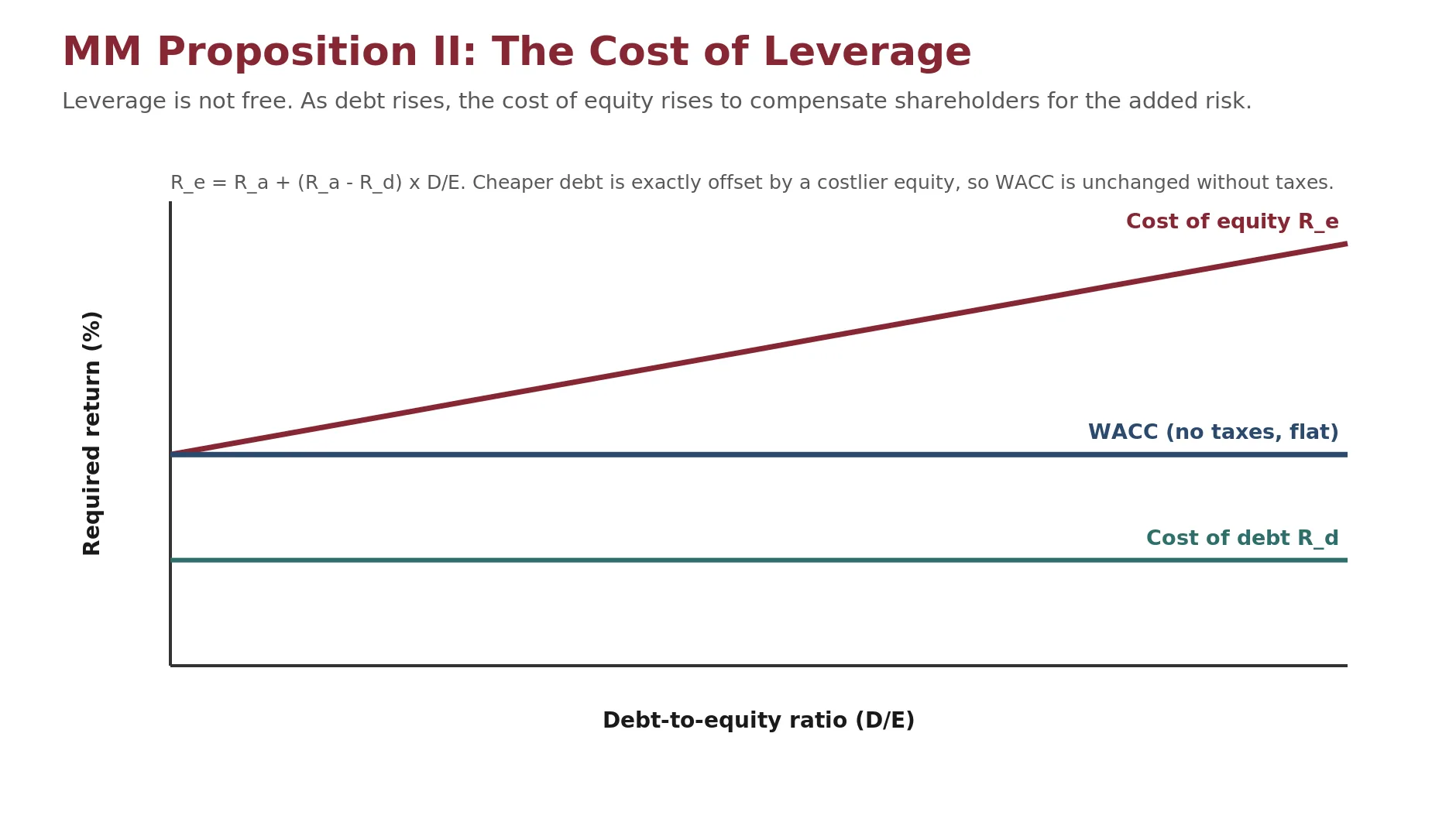
Proposition II follows from the first. If total firm value does not change, then the use of cheaper debt must be offset by something, and that something is the cost of equity, which rises with leverage. The relationship is linear in the debt-to-equity ratio: the cost of equity equals the unlevered return plus a premium that grows with leverage. Adding debt does not lower the average cost of capital in a frictionless world, because the cheaper debt is precisely offset by a costlier, riskier equity.
Key relationship. MM Proposition II: R_e = R_a + (R_a − R_d) × D/E. The cost of equity rises with leverage to offset the cheaper debt.
Worked example
A firm's unlevered return R_a is 12% and its cost of debt R_d is 6%. At a debt-to-equity ratio of 1.0, the cost of equity is 12% + (12% − 6%) × 1.0 = 18%. The WACC, a 50/50 blend of 6% debt and 18% equity, is 12%, exactly the unlevered return. Leverage rearranged the risk between debt and equity holders without changing the total value.
Adjust the unlevered return, cost of debt, and D/E to see the cost of equity rise. The defaults reproduce the worked example (Rₐ 12%, R_d 6%, D/E 1.0 → R_e 18%, WACC 12%).
Check Your Understanding
Knowledge Check 2
Capital Structure & Venture Debt
Modigliani and Miller (1958) showed that in a world without taxes or frictions, firm value is:
Knowledge Check 3
Cost of Capital (WACC) & VC Method
A firm's unlevered return is 12%, its cost of debt is 6%, and its D/E is 1.0. Under MM Proposition II (no taxes), the cost of equity is:
The 1963 Correction: Taxes Break the Irrelevance
Modigliani and Miller (1963) corrected the theory for corporate taxes. Because interest is tax-deductible and dividends are not, debt shields income from tax, and that shield adds value. The levered value becomes the unlevered value plus the tax shield. Value now rises with leverage, which is the first real argument for using debt.
Key relationship. MM with taxes: V_L = V_U + Tc × D. The interest tax shield adds value equal to the corporate tax rate times the debt.
Worked example
A profitable firm worth $80M unlevered adds $30M of permanent debt at a 21% corporate tax rate. Its levered value is $80M + 0.21 × $30M = $86.3M. The $6.3M of added value is the present value of the interest tax shield. This is a real benefit, but only for a firm with taxable income to shield, a condition that fails for most startups, as Part 7 explains.
Adjust the unlevered value, debt, and tax rate to see the interest tax shield. The defaults reproduce the worked example (V_U $80M, D $30M, Tc 21% → shield $6.3M, V_L $86.3M).
Check Your Understanding
Knowledge Check 4
Capital Structure & Venture Debt
A profitable firm is worth $80M unlevered. It adds $30M of permanent debt at a 21% corporate tax rate. Under MM 1963, its levered value is about:
Where This Part Breaks Down
Part Three
The Tradeoff Theory Balances the Tax Shield Against Distress
If the tax shield were the whole story, every firm would use as much debt as possible. It does not, because leverage carries a countervailing cost. The tradeoff theory holds that the optimal capital structure balances the marginal value of the interest tax shield against the marginal cost of financial distress.
Distress Costs Offset the Tax Shield
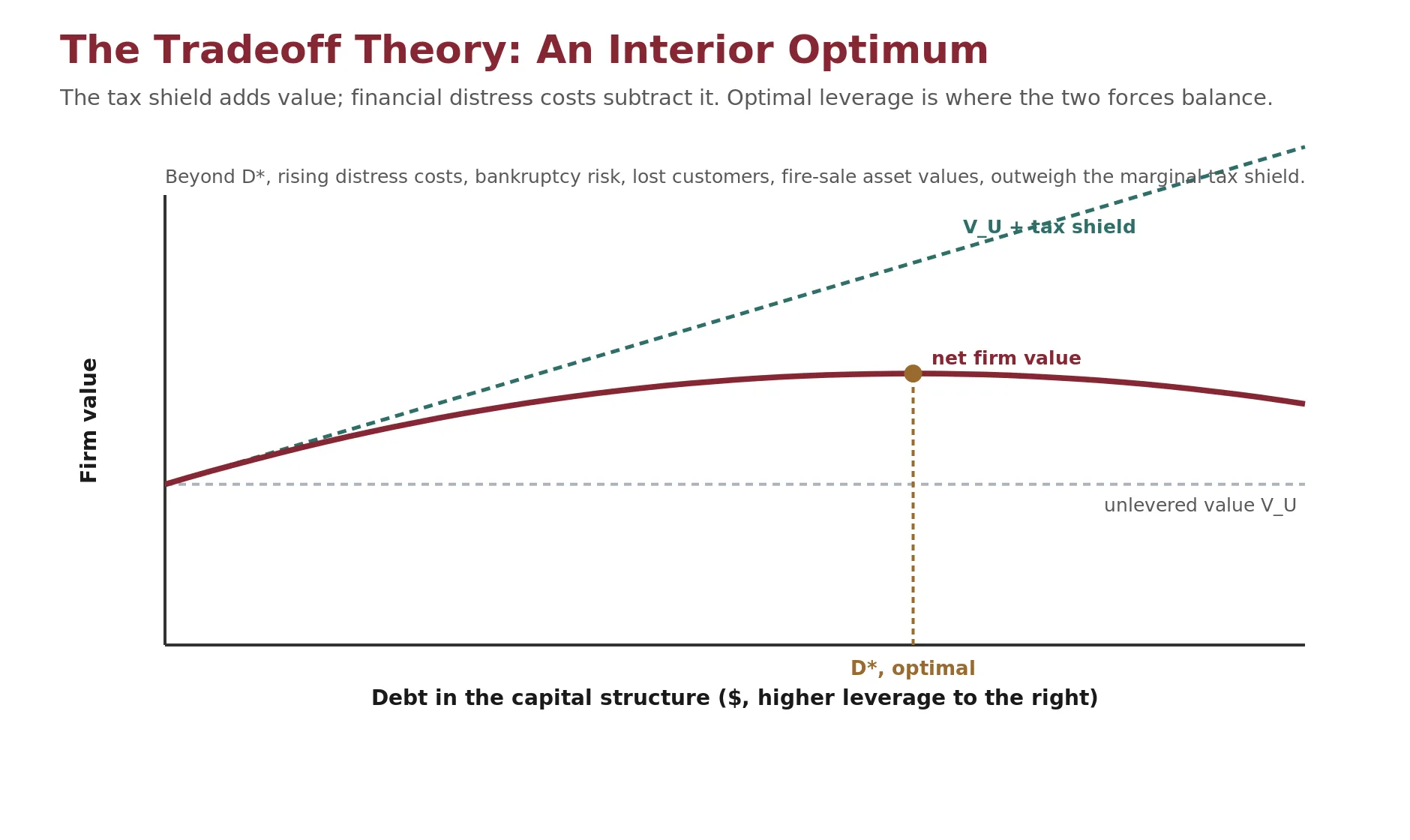
Financial distress costs rise with leverage, and they are more than the direct legal fees of bankruptcy. A highly levered firm loses customers who doubt it will survive, loses key employees, is forced to sell assets at fire-sale prices, and passes up good investments because its cash is committed to debt service. These costs are small at low leverage and accelerate as debt grows.
The optimal amount of debt, marked D* in the figure, is the point where one more dollar of debt adds just as much tax shield as it adds expected distress cost.
Which Firms Carry Debt and Which Do Not
The tradeoff theory explains patterns the frictionless model cannot. Profitable firms with stable cash flows and tangible assets, utilities, manufacturers, and real estate, carry substantial debt, because they can use the shield and their assets limit distress costs. Firms with volatile cash flows and few tangible assets, such as early-stage technology companies, typically carry little debt, because the distress costs would tend to swamp the shield, and the shield does little without profits to begin with.
Check Your Understanding
Knowledge Check 5
Capital Structure & Venture Debt
The tradeoff theory says the optimal amount of debt is the point where:
Part Four
The Pecking Order Explains Financing Choices Under Asymmetric Information
A third theory drops the assumption that managers and investors share the same information. Myers and Majluf (1984) showed that when managers know more about a firm's prospects than the market does, the financing choice itself carries a signal, and that signal reorders the sources of capital into a pecking order: internal funds first, then debt, then equity.
The Pecking Order
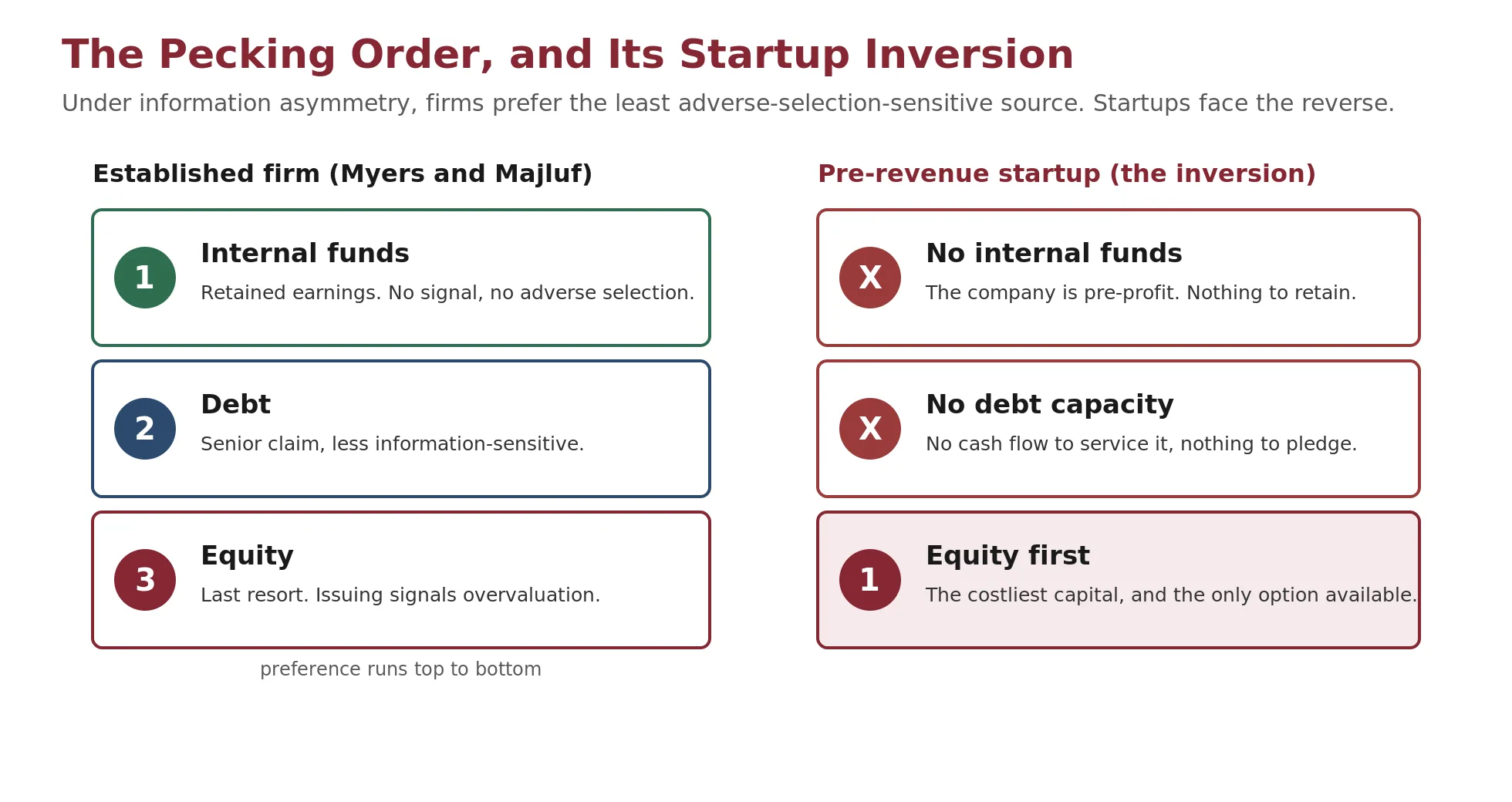
The logic is adverse selection. When a firm issues equity, the market reasons that managers, who know more, would rather sell shares they believe are overvalued, so the price falls on announcement. Debt carries far less of this problem, because a senior, fixed claim is much less sensitive to whether the firm is over- or under-valued. Internal funds carry none of it, since no security is issued and no signal is sent. Firms therefore fund investment from retained earnings first, turn to debt when internal funds run short, and issue equity only as a last resort.
Check Your Understanding
Knowledge Check 6
Capital Structure & Venture Debt
Under the pecking order theory, a firm with a choice prefers to finance in which order?
The Startup Inversion
The startup inversion: for a pre-revenue startup, the pecking order runs backward. There are no internal funds, because the company is pre-profit. There is no debt capacity, because there is no cash flow to service a loan and no assets to pledge. The founder must sell equity first, the most expensive capital, precisely because no cheaper option exists. This is the central irony of startup finance, that the companies that can least afford to give up ownership are forced to give up the most.
Check Your Understanding
Knowledge Check 7
Capital Structure & Venture Debt
Why does the pecking order invert for a pre-revenue startup?
Part Five
Agency Costs and Signaling Shape the Decision Too
Two further forces refine the picture. Both arise from the same root as the pecking order, the fact that the parties to a financing do not share the same interests or the same information.
Agency Costs, Jensen and Meckling (1976)
Two agency costs of capital structure
Jensen and Meckling (1976) showed that capital structure creates conflicts of interest, and that resolving them is costly. There is an agency cost of outside equity: a manager who owns only a small slice of the firm captures little of the gain from hard work but bears little of the cost of perks and empire-building, so weaker ownership can dull incentives. There is also an agency cost of debt: once a firm is levered, shareholders can favor risky projects whose upside is theirs and whose downside falls on lenders, a behavior called asset substitution, and they may pass up safe, positive-value projects whose gains would accrue mainly to the lenders, a behavior called underinvestment.
Debt as discipline: the free-cash-flow argument
Jensen (1986) added a benefit that runs the other way. For a mature firm generating more cash than it has good projects, debt can be a discipline. The obligation to make interest payments forces free cash flow out of the company rather than letting managers waste it on low-return uses. This free-cash-flow argument is one reason leveraged buyouts can add value in cash-rich, low-growth industries.
Signaling, Ross (1977)
Ross (1977) showed that the financing choice can be a credible signal. A manager who takes on fixed debt payments is betting the company's cash flows can cover them, a bet the manager of a weak firm would avoid, because the penalty for default is severe. Taking on debt therefore signals confidence, and issuing equity signals the reverse. For startups this logic is muted, because pre-revenue firms cannot credibly commit to debt payments at all, but the same instinct explains why a later-stage founder who raises venture debt rather than more equity signals confidence in the plan.
Check Your Understanding
Knowledge Check 8
Capital Structure & Venture Debt
Jensen and Meckling (1976) identified an agency cost of debt in which levered shareholders may:
Part Six
Cost of Capital: What Rate the Money Actually Costs
Every financing choice has a price, and the standard way to measure it is the weighted average cost of capital.
The Weighted Average Cost of Capital
WACC blends the after-tax cost of debt and the cost of equity, each weighted by its share of total capital.
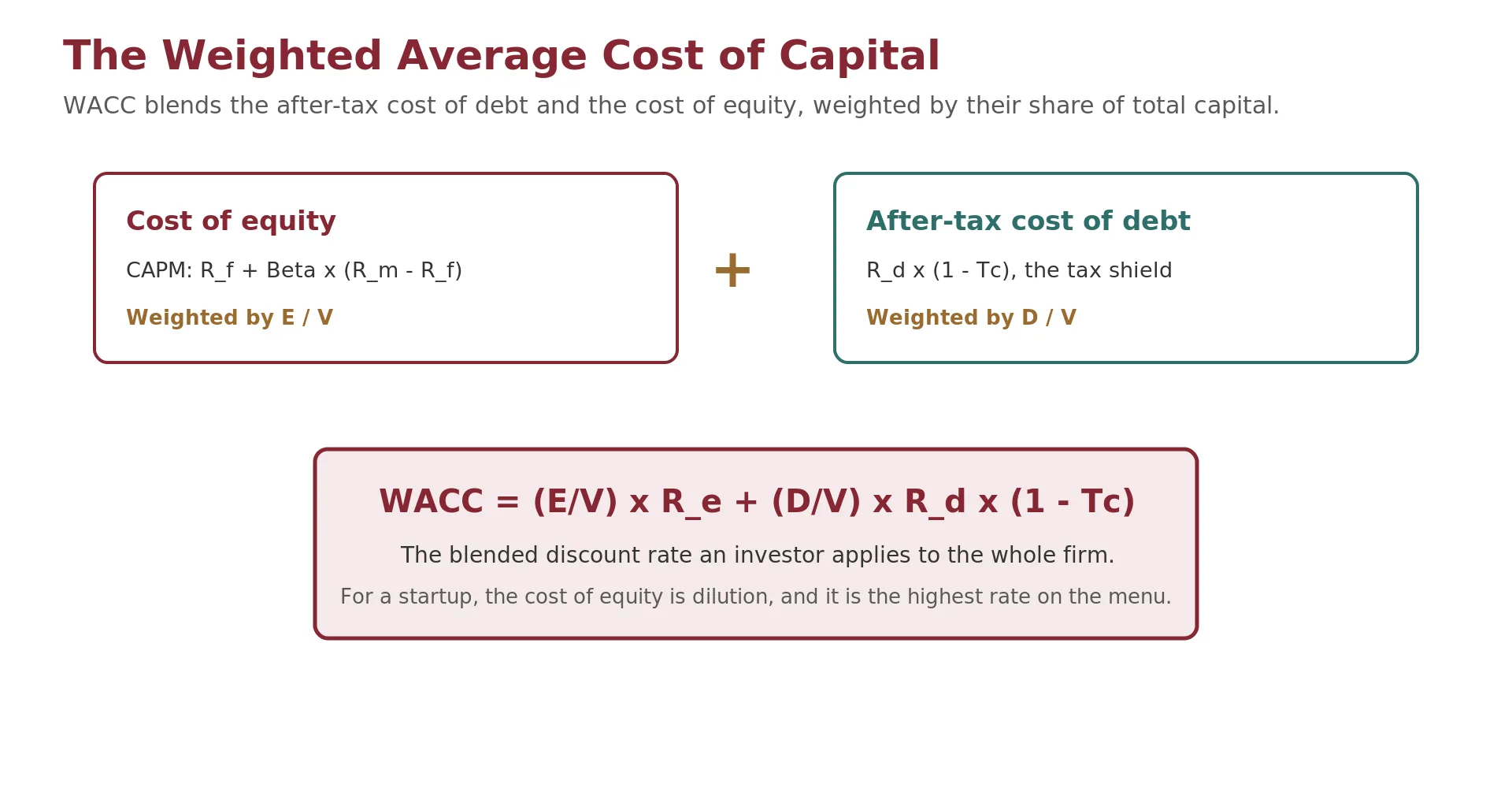
Key relationship. WACC = (E/V) × R_e + (D/V) × R_d × (1 − Tc). The debt term uses the after-tax cost of debt, reflecting the tax shield.
The cost of equity is usually estimated with the capital asset pricing model, the risk-free rate plus beta times the equity risk premium. The cost of debt is the interest rate a lender charges, reduced by the tax shield for a profitable firm. The weights are the market values of equity and debt.
Worked example
A firm is 60% equity and 40% debt. Its cost of equity is 15%, its pre-tax cost of debt is 8%, and its tax rate is 25%. Its WACC is 0.60 × 15% + 0.40 × 8% × (1 − 0.25) = 9.0% + 2.4% = 11.4%. The debt contributes only 2.4%, both because it is a smaller weight and because the after-tax rate is 6%, not 8%.
Adjust the equity weight, cost of equity, pre-tax cost of debt, and tax rate. The defaults reproduce a 60% equity, R_e 15%, pre-tax R_d 8%, Tc 25% case, giving after-tax debt of 6% and WACC of 11.4%.
Check Your Understanding
Knowledge Check 9
Cost of Capital (WACC) & VC Method
A firm is 60% equity and 40% debt. Cost of equity is 15%, pre-tax cost of debt is 8%, and the tax rate is 25%. Its WACC is:
The Startup Reframe
For a pre-profit startup, the cost of equity is not an abstract discount rate. It is the ownership surrendered, and because equity is a residual claim on future value, it is typically the highest cost on the menu. The $750K a founder raises on a SAFE that costs 18.75% of the company is far more expensive, in cost-of-capital terms, than a later venture debt facility that costs a few percent of interest and a fraction of a percent of dilution. The discipline is to price each instrument by what it truly costs in ownership, control, and cash, not by how it feels at signing.
Check Your Understanding
Knowledge Check 10
Cost of Capital (WACC) & VC Method
For a pre-profit startup, the cost of equity is best understood as:
Where WACC Breaks Down
Part Seven
Debt Instruments for Startups, and the Tax-Shield Caveat
The claim that startups cannot use debt is too broad. The instruments differ, and the evidence is more nuanced than the pecking-order inversion alone suggests.
The Instruments
The claim that startups cannot use debt is too broad. The instruments differ, and the evidence is more nuanced than the pecking-order inversion alone suggests.
| Instrument | Description |
|---|---|
| Bank debt | term loans and lines of credit for firms with a revenue history, assets to pledge, or a founder willing to guarantee the loan personally. The cheapest source, but the hardest for an early startup to obtain on the company's own credit. |
| Venture debt | a term loan for venture-backed companies, commonly 25 to 35% of the last equity round, at 8 to 15% interest, with warrants covering 0.5 to 2.0% of fully diluted equity. Its purpose is to extend runway between equity rounds. |
| Revenue-based financing | capital repaid as a percentage of revenue, available once a firm has recurring revenue to share. It carries no fixed repayment schedule, but it requires revenue. |
The Headline Rate Understates the Cost
The coupon on a venture-debt facility understates its true cost. A lender is generally compensated in more than interest, so the effective annual cost combines the coupon with the amortized value of every fee and equity feature the deal carries.
Three items typically sit on top of the coupon:
- A closing or origination fee, a percentage of principal paid up front when the facility funds, which reduces the net cash the borrower actually receives.
- A back-end or final-payment fee, a percentage of principal due at maturity, so the borrower repays more than the face amount even though it never appears in the stated rate.
- Warrant coverage, warrants worth a percentage of the loan that transfer equity value to the lender, giving the lender upside beyond interest.
The right way to compare two facilities is to lay out the full cash-flow schedule, meaning the origination inflow net of the closing fee, the annual interest outflows, and the maturity outflow of principal plus the final-payment fee plus the warrant value, then solve for the internal rate of return of that schedule. The IRR is the effective annual cost. Comparing headline coupons alone generally flatters the facility that carries the higher fees.
Worked Example: Building the All-In Cost
Consider a $2,000,000 facility, interest-only over a three-year term, at a 12% annual coupon. Interest is therefore $240,000 per year.
- Closing fee: 1% of principal, or $20,000, paid at origination.
- Final-payment (back-end) fee: 5% of principal, or $100,000, due at maturity.
- Warrant coverage: 10% of the loan, or $200,000 of warrants. A common rule of thumb values a warrant at a fraction of its face, so treat the recognized cost as roughly $60,000 (an estimate).
The non-interest cost totals $20,000 + $100,000 + $60,000 = $180,000 over three years, about $60,000 per year, or roughly 3% of the $2,000,000 principal each year.
Approximate all-in cost. 12% coupon + about 3% in amortized fees and warrants = roughly 15% per year, versus the 12% headline.
This figure is an approximation. The precise number is the internal rate of return of the full schedule: an origination inflow of $2,000,000 net of the $20,000 closing fee, annual interest outflows of $240,000, and a maturity outflow of $2,000,000 plus the $100,000 final-payment fee plus the roughly $60,000 warrant value. Solving that schedule for its IRR gives the effective annual cost, which sits meaningfully above the stated 12%.
Check Your Understanding
Knowledge Check 15
Capital Structure & Venture Debt
A venture-debt facility quotes a 12% annual coupon but also carries an origination fee, a final-payment fee due at maturity, and warrant coverage. Why does its effective all-in annual cost exceed the 12% coupon?
Knowledge Check 16
Capital Structure & Venture Debt
A $2,000,000 interest-only venture-debt facility carries a 1% closing fee ($20,000), a 5% final-payment fee ($100,000 at maturity), and warrant coverage with an estimated value of $60,000, all over a three-year term. Roughly what is the annualized non-interest cost as a percentage of principal?
The Tax-Shield Caveat
Corporate finance textbooks emphasize the tax advantage of debt, but for a startup it is largely theoretical. A company with no taxable income receives no immediate benefit from an interest deduction.
The deductions create net operating losses that can be carried forward to offset future income, but only if the company becomes profitable, and only subject to Section 382, which limits NOL use after an ownership change exceeding 50%, a threshold that venture rounds frequently cross. A founder should not price the tax shield into the cost of debt at the seed or Series A stage. The benefit is real, but deferred and uncertain.
Check Your Understanding
Knowledge Check 11
Capital Structure & Venture Debt
Why should a pre-profit startup not count the interest tax shield in its cost of debt?
What the Evidence Actually Shows
Robb and Robinson (2014), using the Kauffman Firm Survey, found that new firms rely on formal debt far more than the standard narrative assumes. In their data the average amount of bank financing was roughly seven times the average amount of insider debt, and formal bank debt was one of the three largest sources of startup capital, alongside owner equity and business credit.
The reconciliation matters: much of that debt is guaranteed by the founder personally or secured by personal assets, so the entrepreneur effectively holds a levered equity claim in the startup. The company has borrowed, but the founder, not the company's cash flows, carries the risk. A pre-revenue company with a prototype, no revenue, and no assets is the true no-capacity case; a founder with a house to pledge or strong personal credit is not.
Check Your Understanding
Knowledge Check 12
Capital Structure & Venture Debt
Contrary to the common view that startups fund themselves mainly with equity and insider money, evidence on newly founded firms indicates that they rely substantially on which source?
Part Eight
The Capital Stack, Venture Debt, and Beyond Money
The right capital structure is not fixed. It shifts across the company's lifecycle, and the same instrument can be cheap runway or a cliff. This part follows the capital stack from the development stage through growth and scale, examines when venture debt helps and when it becomes a trap, weighs the beyond-money costs of control and the rich-versus-king tradeoff, and closes with the limits of the module.
The Capital Stack Evolves Across the Lifecycle
The right capital structure is not fixed. It shifts as the company's cash flow becomes more predictable and its debt capacity grows. The guiding principle is to match the instrument to the stage: equity when cash flow is uncertain, debt once it can be serviced.
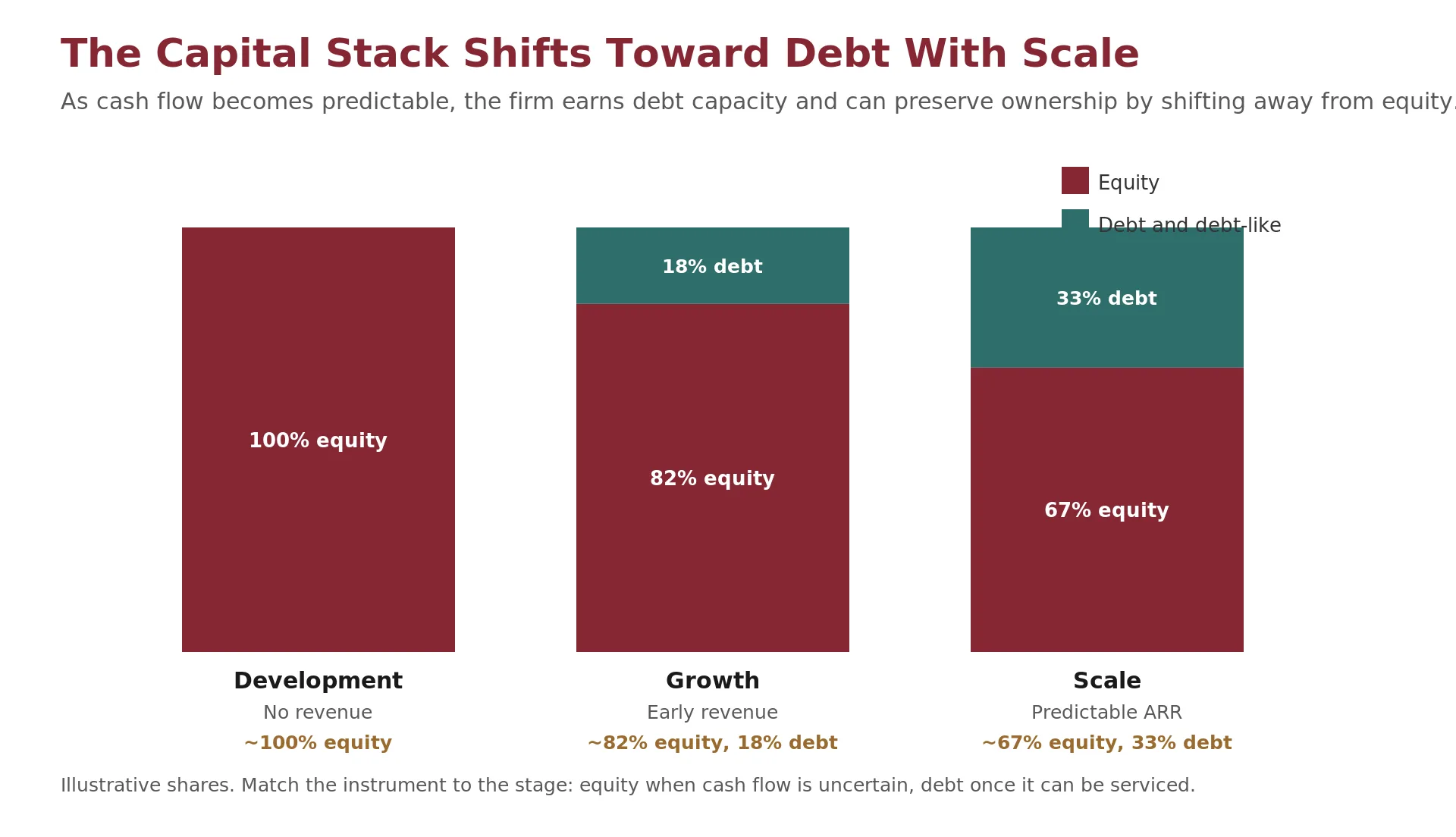
At the development stage, with no revenue, the company is essentially all equity, because nothing can service debt. At the growth stage, with early revenue, priced rounds and a first slice of venture debt appear, and a typical company might be about 82% equity and 18% debt. At the scale stage, with predictable recurring revenue, the company earns real debt capacity, adds revolving credit and larger venture debt, and the mix might shift to about 67% equity and 33% debt. Every dollar financed with debt at the later stages is a dollar the founder did not have to dilute for.
The lesson is sequencing. A founder who matches capital to the stage does not take venture debt before the growth trajectory can service it, and does not pursue bank credit before the revenue history can qualify for it. The most expensive capital is usually the earliest, raised when the company is riskiest and its valuation lowest, so the discipline is to delay equity as long as possible and shift to debt as soon as the company can support it.
When Debt Helps, and When Venture Debt Becomes a Trap
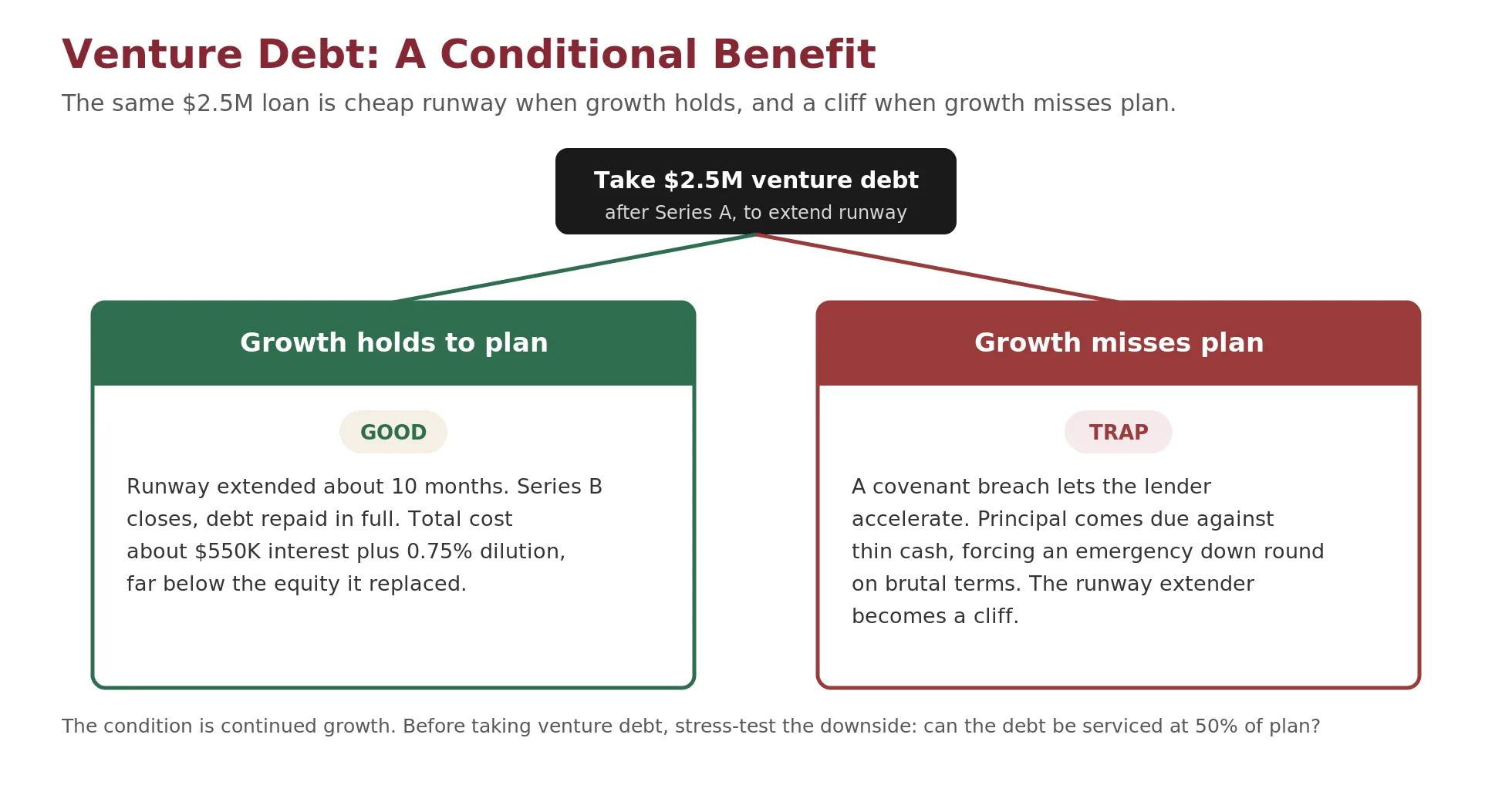
Venture debt is useful precisely when things are going well, and dangerous precisely when they are not. It is not free optionality; it is a conditional benefit, and the condition is continued growth.
A worked example
Consider a founder who raises $8M in Series A and takes $2.5M in venture debt, roughly 31% of the round, on a 36-month term with six months of interest-only payments at 11%, subject to a covenant requiring at least $1.5M of cash on hand and minimum revenue milestones. If growth holds, the debt works exactly as designed. It extends runway by about ten months, the founder hits the milestones, closes a $20M Series B, and repays the debt in full. The total cost is about $550K of interest plus 0.75% of dilution from the warrants, trivial against the equity the founder would have surrendered raising another $2.5M.
Adjust the debt amount, round size, monthly burn, interest rate, and term to see venture debt as cheap runway or a cliff. The defaults reproduce a representative example: $2.5M of venture debt on an $8M round is about 31% of the round, extends runway by about ten months, and costs about $550K of interest.
When Growth Misses
If growth misses, the same instrument turns dangerous. A covenant breach lets the lender accelerate, so the remaining principal comes due immediately, against a thin cash balance. Paying it leaves only a few months of runway, and most investors the founder approaches will recognize that the company is distressed. The rescue round is a down round on brutal terms, a lower valuation with a participating preference and full-ratchet antidilution. The runway extender has become a cliff.
The advisory takeaway is to stress-test the downside before signing. If revenue growth comes in at half of plan, can the company still service the debt and hold its covenants? If the answer is no, the debt is not extending runway; it is creating a cliff, and the founder should raise more equity, size the debt smaller, or negotiate looser covenants.
Check Your Understanding
Knowledge Check 13
Capital Structure & Venture Debt
Venture debt is most dangerous to a startup when:
Beyond Money: Control, Signaling, and the Rich-Versus-King Tradeoff
The capital structure decision is not only about the cost of money. It is also about control, because every dollar of outside capital, debt or equity, comes with conditions, and those conditions compound across rounds just as dilution does.
Wasserman (2012) documented the tradeoff in a large sample of founders. Those who raised venture capital built more valuable companies on average, but were significantly more likely to be replaced as CEO. He framed the choice as rich versus king: a founder can optimize for wealth, giving up equity and control to grow the pie, or for control, holding a larger slice of a smaller company, but rarely both. Raising capital tends to make the founder richer and less kingly.
This reframes the whole module. Debt preserves ownership and control but demands cash the company may not have. Equity relieves the cash pressure but surrenders ownership and, through board seats and protective provisions, a measure of control. Convertibles and SAFEs defer the choice but do not escape it. The disciplined founder prices every instrument by its full cost, ownership, control, and cash, and matches it to the company's stage and cash-flow reality, rather than reaching for whatever capital feels cheapest at the moment of signing.
Check Your Understanding
Knowledge Check 14
Governance & Board Dynamics
Across large samples of startup founders, those who raise venture capital, compared with founders who bootstrap, tend on average to:
Limits of This Module
This module explains the theory and practice of the capital structure decision. It is not investment, legal, or tax advice, and the instruments, tax rules, and market conventions described change over time and depend on the specific facts.
The worked examples use clean, rounded inputs to isolate one mechanic at a time. Modigliani and Miller assume perfect markets, and the real decision blends taxes, distress costs, agency effects, and information asymmetry at once.
The startup framing is deliberate. Much of classic capital structure theory was built for mature, profitable firms, and its results invert or fail for pre-profit companies, which is a central theme of this module rather than an exception.
Venture debt and net-operating-loss figures are current conventions and reflect the sources cited. The tax treatment of interest, NOLs, and carried interest is subject to legislative change.