
Week 6CHAPTER 06
Cap Tables, Dilution, and Deal Terms
A deep dive on the equity itself: who owns what, who gets paid, and how ownership erodes round by round. The cap table as the founder’s financial constitution and why fully diluted is generally the fairest basis for comparison; equity classes and the liquidation stack; the three forms of liquidation preference and how they reshape every exit; SAFEs and convertible notes as the default pre-seed instruments; conversion mechanics and the hidden cost of liquidation-preference overhang; the option pool and the pre-money vs. post-money shuffle; the equity waterfall and how dilution compounds across rounds; and antidilution, term-sheet economics vs. control, vesting, and the 83(b) election, with five interactive calculators.
~125 min8 sections52 questions6 tools
Learning objectives (9)
Learning Objectives
By the end of this chapter you should be able to:
- 1Read a capitalization table and explain why fully diluted ownership is the soundest basis for comparing offers.
- 2Distinguish common from preferred stock and order the liquidation stack from secured debt down to common.
- 3Compare nonparticipating, participating, and capped-participating preferred and show how each reshapes founder proceeds at an exit.
- 4Explain how SAFEs and convertible notes work as pre-seed instruments, and why the post-money SAFE fixes each investor's ownership at signing.
- 5Trace conversion mechanics and the liquidation-preference overhang that discounted or capped instruments create.
- 6Analyze the option pool and the pre-money versus post-money distinction, and compute investor and founder ownership after a priced round.
- 7Build an equity waterfall and show how founder dilution compounds across successive rounds.
- 8Compare full-ratchet and weighted-average antidilution and their effect on founder ownership in a down round.
- 9Read a term sheet as a package of economics and control terms, and explain vesting, acceleration, and the 83(b) election.
Part One: The Cap Table Is the Founder's Financial Constitution. Section 1 of 8.
Part One · The Cap Table Is the Founder's Financial Constitution
The Cap Table Is the Founder's Financial Constitution
The Cap Table Is the Founder's Financial Constitution
Every equity decision a founder makes, from issuing stock to hiring employees to raising capital, flows through one document: the capitalization table. The cap table is the ledger of ownership. It records who holds what, how many shares exist, and what percentage of the company each stakeholder controls. A founder who does not understand the cap table tends to make decisions that are difficult to reverse.
The Foundation
A corporation begins by authorizing a large number of shares, commonly 10 to 20 million, and issuing a subset to the founders. The distinction matters. Authorized shares are available to be issued later, while issued shares represent actual ownership, and only issued shares appear on the cap table.
Formula. Share price = equity value / fully diluted share count. Fully diluted shares include issued common, all outstanding options, the shares reserved in the option pool, and every share issuable on conversion of preferred stock, SAFEs, and notes.
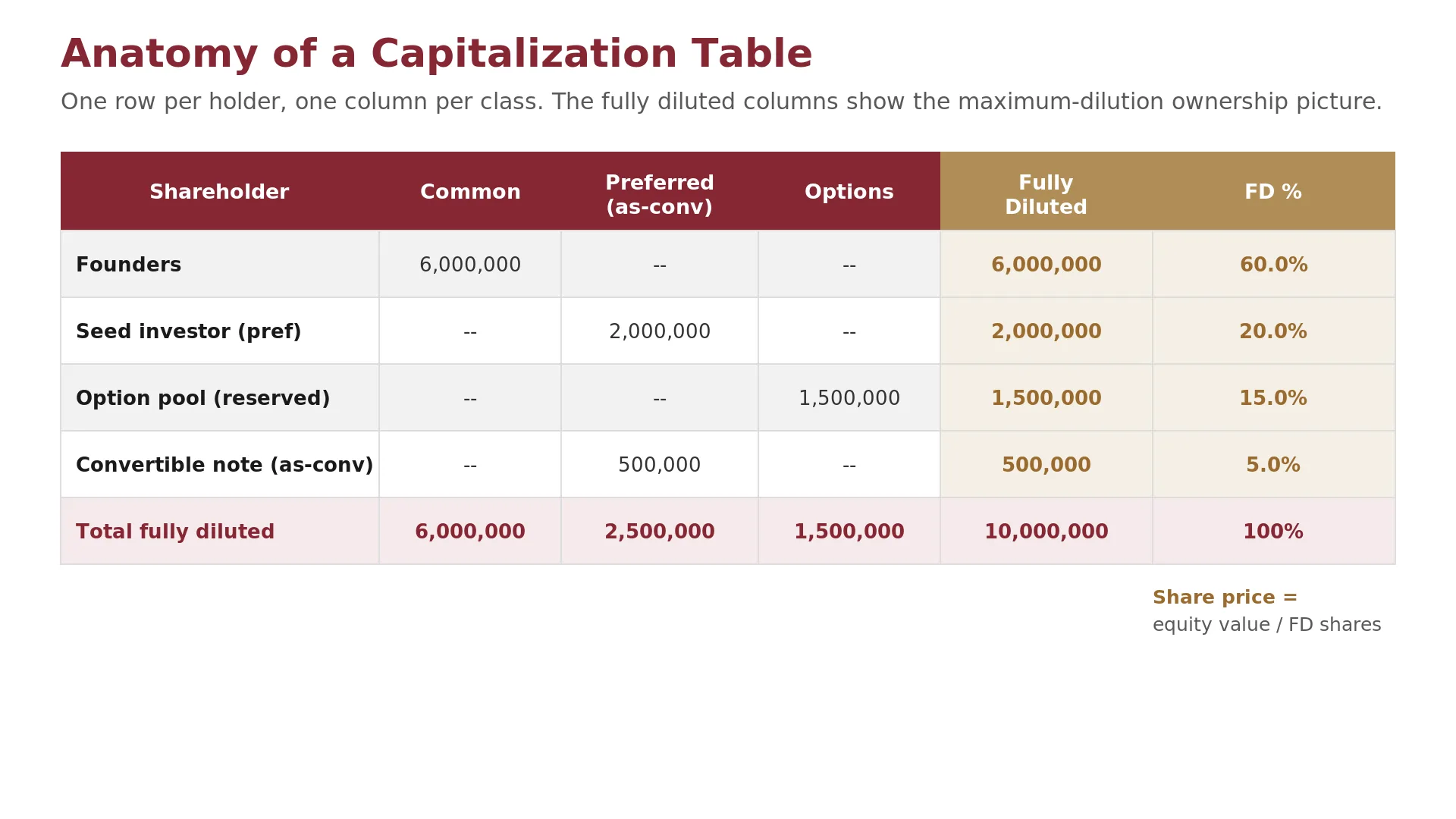
Reading a cap table correctly requires recognizing that the fully diluted columns show the maximum potential dilution. Unvested options and ungranted pool shares are included even though they may never vest or be issued. The rightmost columns, fully diluted shares and fully diluted ownership, are the numbers that matter in a financing.
Check Your Understanding
Knowledge Check 1
Cap Tables & Dilution
A startup authorizes 10 million shares and issues 6 million to its founders. What does the cap table record as outstanding?
Knowledge Check 2
Cap Tables & Dilution
A company is worth $12 million in equity value and has 8 million fully diluted shares. What is the per-share price?
Define Fully Diluted Before Comparing Offers
The meaning of fully diluted varies with what is included. Issued common, preferred as-converted, vested and unvested options, the unallocated pool, warrants, SAFEs, and notes may each be treated differently. Investors sometimes use a fully diluted pre-money figure in a way that shifts dilution onto founders. When a term sheet arrives without a pro forma cap table, request one before continuing the conversation, because verbal descriptions of ownership percentages are often unreliable.
Part Two
Equity Class Determines Who Gets Paid and When
Not all equity is equal. The class of stock a holder owns determines both voting power and, more consequentially, the order and size of payment in a liquidation. Understanding the hierarchy of equity classes is the foundation for reading the waterfall introduced later in this module.
Common Stock Is Last in Line
Common stock is the simplest security. It entitles the holder to a proportional share of equity value, so a holder of 100 of 1,000 shares owns 10% and receives 10% of proceeds in a liquidation. Founders and employees hold common stock, and in a liquidation common is paid only after all debt and preferred obligations are satisfied.
Preferred Stock Carries the Rights That Matter
Most venture investments are structured as preferred stock, which carries rights that common lacks:
- a liquidation preference
- possible dividend rights
- antidilution protection
- and a right to convert to common
Kaplan and Strömberg (2003) analyzed 213 venture financings and found convertible preferred stock in 204 of them, used precisely because it lets investors allocate cash flow rights, voting rights, board rights, and liquidation rights separately.
Liquidation preference: The most consequential feature. In an acquisition or shutdown, preferred holders receive a multiple of their original investment before common receives anything. The standard is a 1x preference, meaning investors get their money back first. A 2x preference pays twice the investment before common sees a dollar.
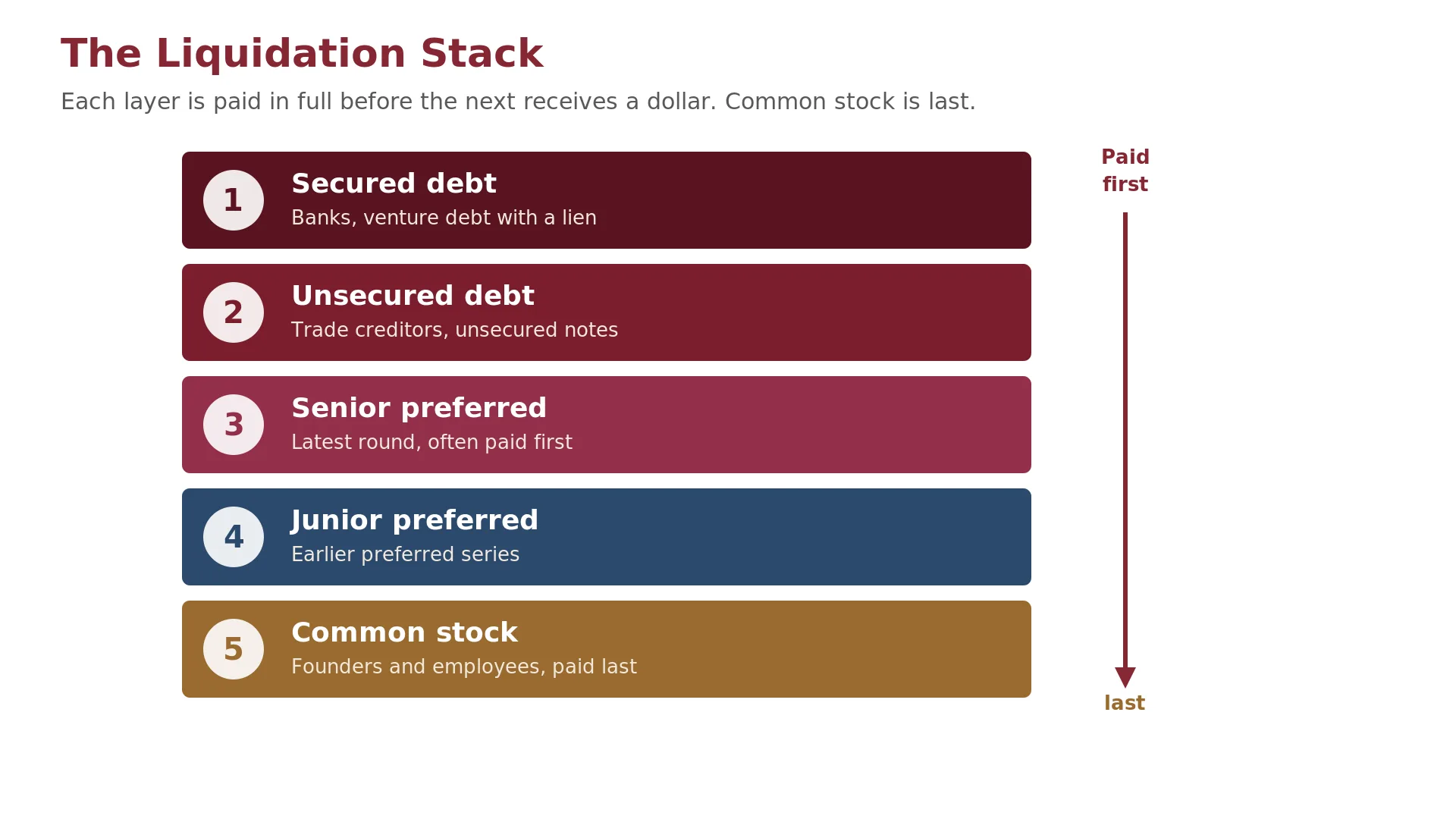
The stack runs from secured debt, to unsecured debt, to the most senior preferred, to junior preferred, and finally to common. By the rules of seniority, each layer is satisfied in full before the next receives any proceeds, which is why the class of security, not just the number of shares, determines the economic outcome.
Check Your Understanding
Knowledge Check 3
Term Sheets & Liquidation Preferences
In priced venture capital financings, which type of security do investors most commonly use, and why?
Part Three
Liquidation Preferences Reshape Every Exit
Preferred stock comes in three primary forms, and the differences between them are dramatic. The form determines how the investor and the common holders split proceeds at every exit value, and the effect is largest at the modest exits that most venture-backed companies actually reach.
The Three Forms
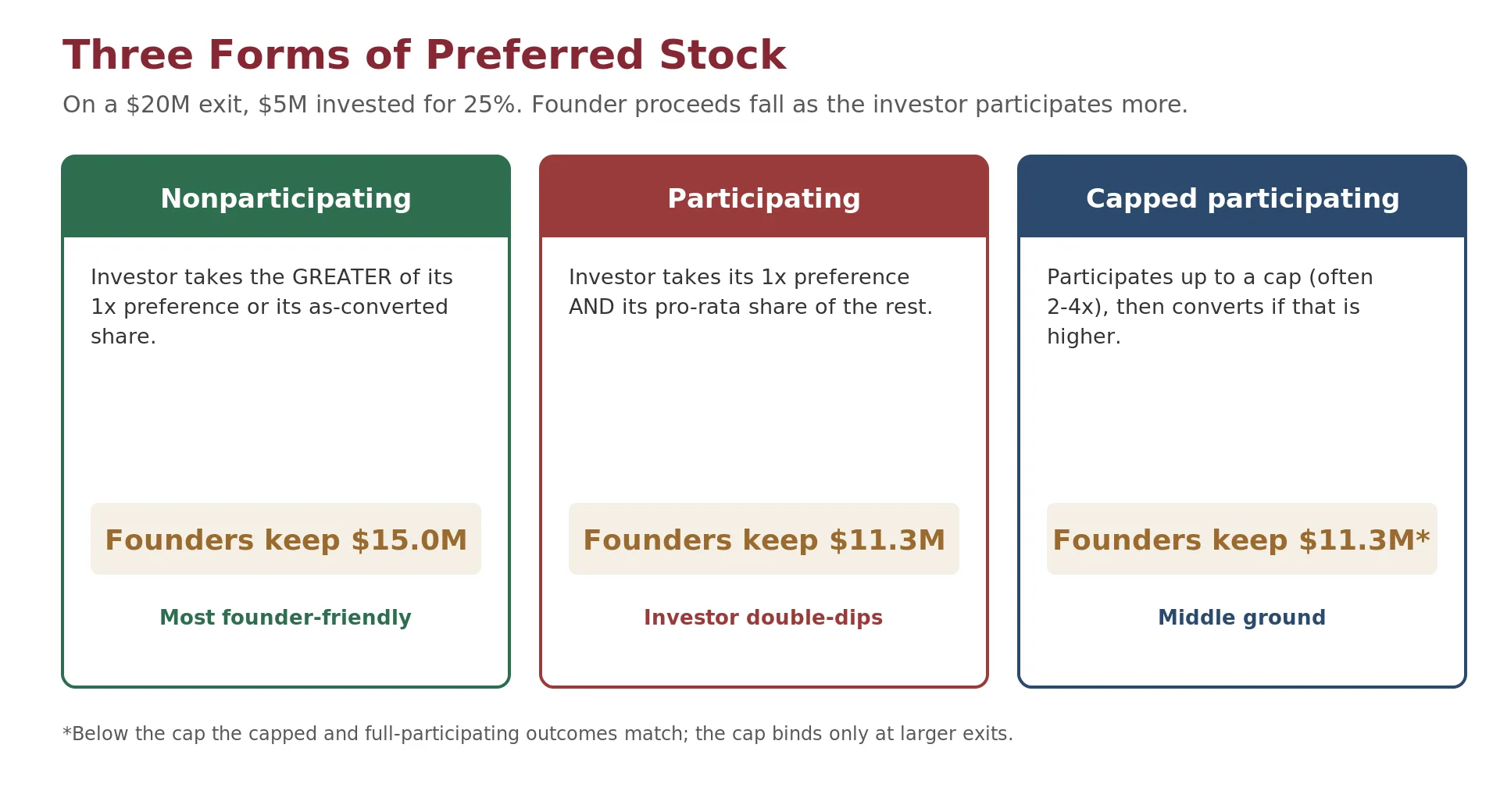
| Form | Mechanism | Founder impact |
|---|---|---|
| Nonparticipating | Investor takes the greater of its preference or its as-converted share | Most founder-friendly; the NVCA model default |
| Participating | Investor takes its preference and also shares pro rata in the remainder | Least founder-friendly; the investor double-dips |
| Capped participating | Participates up to a cap, commonly 2 to 4x, then converts if higher | A middle ground; the cap limits the double-dip |
Worked example. A company raises $5M for 25% of the fully diluted equity. At a $20M exit, the split depends entirely on the preferred form.
- Nonparticipating: the investor takes the greater of its $5M preference or 25% of $20M, which is also $5M. The two are equal here, so the investor takes $5M and common keeps $15.0M.
- Participating: the investor takes its $5M preference, then 25% of the remaining $15M, which is $3.75M, for $8.75M in total. Common keeps $11.25M.
- Capped participating with a 3x cap: below the $15M cap the outcome matches participating, so common keeps $11.25M. The cap binds only at much larger exits.
The gap between nonparticipating and participating, $3.75M of common proceeds on a single $20M exit, is not an edge case. Most venture-backed exits are acquisitions rather than IPOs, and many are modest in size (Metrick and Yasuda, 2021), so the preferred form drives the founders' outcome in the majority of real deals.
Set investment to $5M, a 1x preference, 25% ownership, and a $20M exit to reproduce the figure's nonparticipating case: $5M to the investor and $15M to common.
Check Your Understanding
Knowledge Check 4
Term Sheets & Liquidation Preferences
How does participating preferred differ from nonparticipating preferred for the common holders?
Knowledge Check 5
Term Sheets & Liquidation Preferences
A $5M investor holds 25% via 1x participating preferred. At a $24M exit, what do common holders receive?
Part Four
SAFEs and Notes Are the Default Pre-Seed Instruments
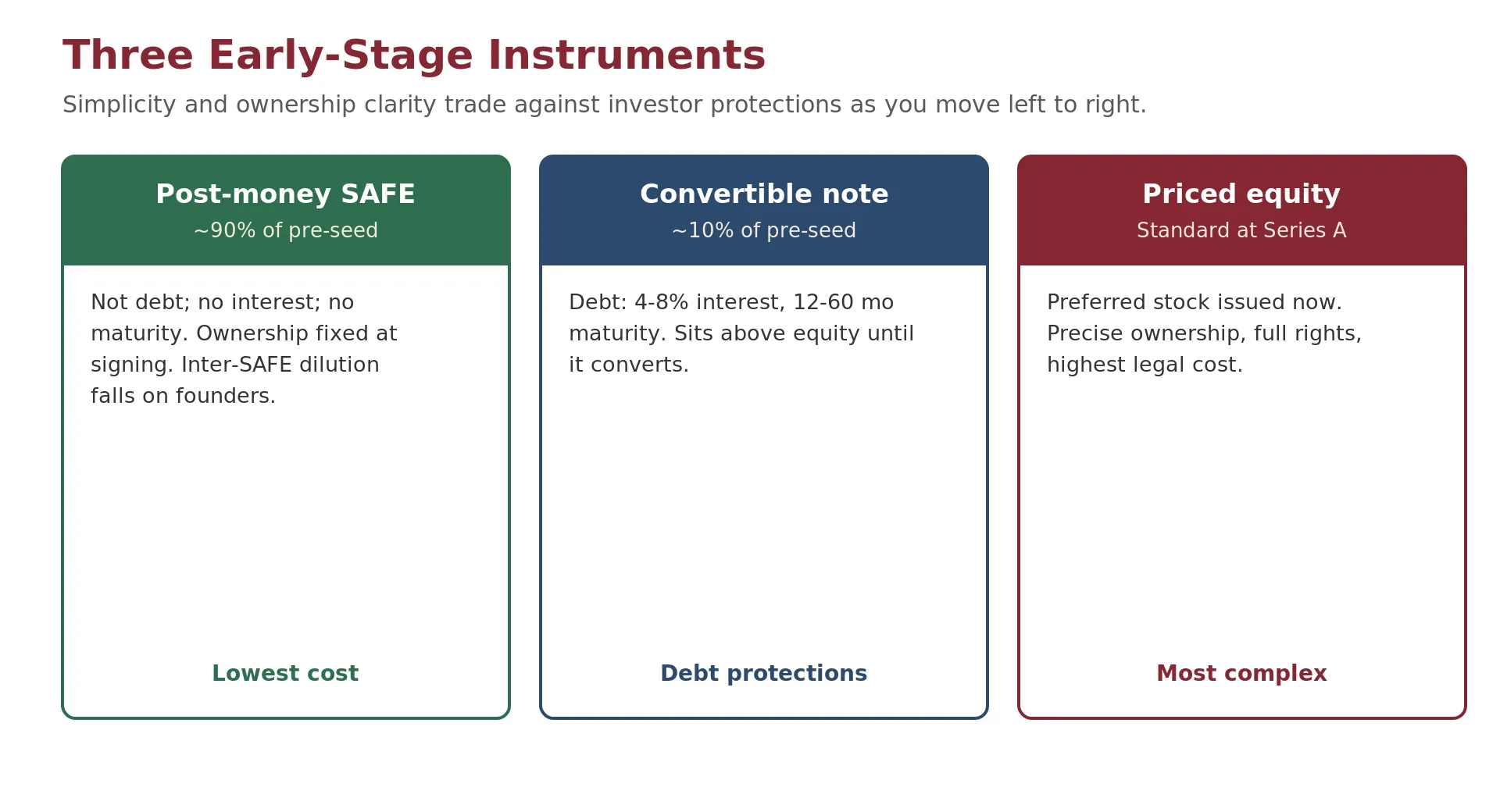
Before a company raises a priced equity round, it typically raises through instruments that convert into equity later. The two primary instruments are convertible notes and SAFEs, Simple Agreements for Future Equity. As of Q1 2025, SAFEs accounted for roughly 90% of pre-seed deals tracked on Carta, with convertible notes making up most of the remainder.
The Convertible Note Is Debt Until It Converts
A convertible note is debt that converts to equity when the company completes a qualifying financing. Its key terms are the principal, an interest rate of typically 4 to 8% accruing as simple interest, a maturity date of 12 to 60 months, a conversion discount of 10 to 30%, and often a valuation cap.
Formula. Discounted conversion price = priced-round share price x (1 - discount). With a valuation cap, the note converts at the lower of the discounted price or the implied cap price.
Because a note is debt, it sits above equity in the liquidation stack. If the company shuts down before conversion, note holders are repaid before founders and employees receive anything. This asymmetry is one reason SAFEs have gained share, since a SAFE is not a debt security and does not create that dynamic.
The Post-Money SAFE Fixes Ownership at Signing
Y Combinator introduced the SAFE in 2013 and replaced it with the post-money SAFE in 2018, which has become the market standard. As of Q3 2024, 87% of SAFEs on Carta were post-money. Under a post-money SAFE, the valuation cap represents a post-money valuation that includes all SAFE money but excludes the new priced-round money, so each investor can calculate exact ownership at the time of investment. A $100K investment on a $10M post-money cap equals exactly 1% at conversion, regardless of how many other SAFEs the company issues.
This clarity has a cost to founders. Under the post-money SAFE, all dilution from additional SAFEs falls on the common holders. If a company sells $500K on a $5M post-money cap and then sells another $500K on the same cap, each investor still owns 10%, and the founders have been diluted by 20% in total. Under the older pre-money SAFE, the two investors would have shared the dilution from each other's investment.
Enter a SAFE investment against a post-money valuation cap to see the ownership it locks in. The defaults reproduce a worked example in which $500K on a $5M post-money cap fixes the investor at 10%, while other SAFEs on the same cap dilute the founders rather than the SAFE holders.
Check Your Understanding
Knowledge Check 6
SAFEs & Convertible Notes
Under a post-money SAFE, who bears the dilution when a company issues additional SAFEs at the same cap?
Knowledge Check 7
SAFEs & Convertible Notes
A company shuts down before its convertible note converts. Where does the note holder stand?
Conversion Mechanics Decide Founder Dilution
When a company raises its first priced round, outstanding SAFEs and notes convert to preferred stock. Whether the conversion is treated as fixed pre-money or fixed post-money changes the share price and the founders' dilution, even though the headline valuation is identical.
Under the fixed pre-money method, the note converts at the stated pre-money price. The new investors keep their price, and the existing holders absorb the note. Under the fixed post-money method, the stated pre-money is treated as a fixed post-money target, so the share price drops to fit the note inside the valuation, and the founders absorb more of the dilution.
Worked example
A company has 8,000,000 founder shares and raises $3M at a $9M pre-money valuation. A prior $1M convertible note, at 8% simple interest for one year, converts with a 25% discount. The note balance at conversion is $1M x 1.08 = $1.08M.
- Fixed pre-money method: the pre-money price is $9M / 8,000,000 = $1.125. The note converts at a 25% discount, so at $0.84375, giving about 1,280,000 shares. The investor buys $3M / $1.125 = about 2,666,667 shares. Founders retain 8,000,000 of about 11,946,667 fully diluted shares, or 67.0%.
- Fixed post-money method: the $9M is treated as a fixed post-money target. Fitting the note inside it lowers the price to about $0.945, the note converts at $0.70875, and the fully diluted count rises to about 12,698,413. Founders retain 8,000,000 of that, or 63.0%.
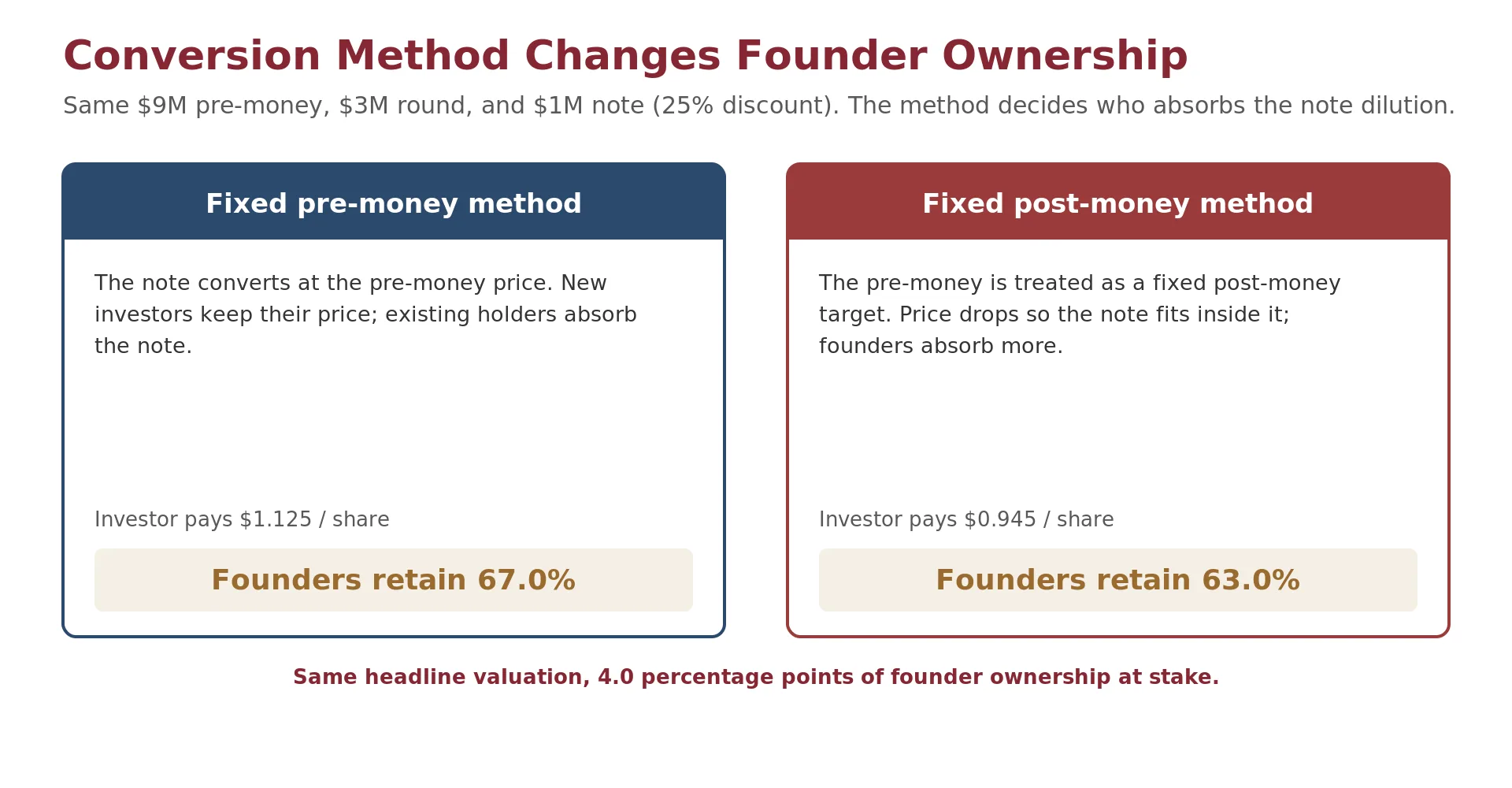
The same headline valuation produces a 4.0 percentage point difference in founder ownership. The lesson is not to memorize one method but to require a pro forma cap table for the specific term sheet, because the label alone does not tell the founder who bears the conversion dilution.
Run the conversion both ways: enter the founder share count, the round, and the note's principal, interest, years outstanding, and discount. The calculator prices the round under the fixed pre-money and fixed post-money methods side by side and shows the founder-ownership gap. The defaults reproduce the worked example above (8,000,000 founder shares, $3M at a $9M pre-money, a $1M note at 8% for one year with a 25% discount), giving 67.0% versus 63.0%, the same headline valuation four points apart.
Check Your Understanding
Knowledge Check 8
SAFEs & Convertible Notes
Compared with the fixed pre-money method, the fixed post-money conversion method does what to founders?
409A Valuations Set the Strike Price
Every conversion and preference we have discussed feeds a cap table that also has to price the options a startup grants its employees. Under Internal Revenue Code Section 409A, a private company must grant stock options with a strike price at or above the fair market value of its common stock at the grant date. Grant below that fair market value and the option is treated as deferred compensation, exposing the employee to immediate income tax on the spread as it vests, a 20% additional federal tax, and interest charges. Those penalties fall on the employee, not the company, so mispricing a grant is a serious harm to the people it was meant to reward.
To avoid that outcome, startups obtain a 409A valuation, a qualified appraisal of the common stock by an independent party. A valuation that meets the requirements creates a safe harbor, meaning the strike price is presumed reasonable and the burden shifts to the IRS to rebut it rather than to the company to defend it. That presumption is why boards rely on an outside appraisal instead of setting the price themselves.
The 409A value of the common stock generally sits below the price investors just paid for preferred stock. Preferred carries a liquidation preference, and often dividends and control rights, that common lacks, so a share of common is worth less than a share of preferred bought in the same company. That gap is the source of the low strike prices that make employee options attractive, since employees buy in near the common value while investors paid the higher preferred value.
- A 409A valuation is generally refreshed every 12 months, because a safe harbor appraisal is treated as reliable for up to a year absent new information.
- It is also refreshed upon a material event, such as closing a new priced round or entering serious financing or acquisition discussions, since such events tend to change what the common stock is worth.
Check Your Understanding
Knowledge Check 10
Cap Tables & Dilution
A private startup pays an independent appraiser for a 409A valuation before granting stock options. What does obtaining that valuation primarily accomplish?
Knowledge Check 11
Cap Tables & Dilution
In a venture-backed startup, the 409A common stock value is generally set below the price investors just paid for preferred stock. What best explains that gap?
The Option Pool Is Dilution You Negotiate Before Investors Arrive
Early-stage companies reserve an option pool, commonly 10 to 20% of fully diluted shares, to compensate future employees with options or restricted stock. The pool appears on the cap table as authorized but ungranted shares, and it dilutes all existing holders. The critical negotiation is whether the pool is created pre-money or post-money.
Most investors require a pre-money pool, meaning the pool is sized before the investment is priced. A pre-money pool is carved out of the pre-money valuation, so the founders alone bear its dilution. A post-money pool is added after the investment and shared pro rata, so all holders, including the new investor, bear it.
Worked example. A company raises $5M at a $15M pre-money valuation, a $20M post-money, and the investor requires a 15% option pool. The founders held 100% before the round.
- Post-money pool: the investor buys 25% for $5M, leaving founders at 75%. A 15% pool that is added and shared pro rata multiplies existing holders by 0.85, so founders end at 75% x 0.85 = 63.75% and the investor at 21.25%.
- Pre-money pool: the 15% pool and the 25% investor stake both come out of the founders' pre-round 100%, so founders end at 60.0% while the investor keeps its full 25%.
The pre-money pool costs the founders 3.75 percentage points on the same headline valuation. The defense is to size the pool from a realistic 12 to 18 month hiring plan rather than an arbitrary percentage. An oversized pool is unnecessary dilution, and a bottoms-up hiring plan is the evidence that justifies a smaller one.
Check Your Understanding
Knowledge Check 10
Cap Tables & Dilution
An investor requires the new option pool to be created pre-money. What is the effect on the founders?
Pre-Money and Post-Money Are Not What Most Founders Think
The headline valuation in a term sheet is rarely the number that determines founder ownership. Pre-money and post-money valuations interact with option pool refreshes and converting instruments in ways that change the effective price per share. A founder who negotiates valuation without these mechanics will be surprised by the pro forma cap table.
Formula. Post-money valuation = pre-money valuation + new investment. Share price = pre-money valuation / existing fully diluted shares. Investor ownership = investment / post-money valuation.
These formulas are clean only when there are no option pool changes and no converting instruments. When a pre-money pool refresh and note or SAFE conversions both occur, which is the common case, the post-money share count becomes circular. The share price depends on the total shares, which depends on how many shares the converting instruments receive, which depends on the share price.
Formula. Post-money shares = (existing shares - available options) / (1 - note% - equity% - target pool%), where equity% = investment / post-money and note% = note balance / (post-money x (1 - discount)). The formula resolves the circularity algebraically.
The practical rule is to avoid negotiating valuation in isolation. A $15M pre-money with a 20% pre-money pool and $1M in converting SAFEs yields very different founder ownership than a $15M pre-money with a 10% post-money pool and no converting instruments. The pro forma cap table is the document that reliably states what the founders actually own after the round closes.
Set the pre-money valuation, the investment, and the option-pool size, then toggle the pool between pre-money and post-money to watch founder, investor, and pool ownership shift. The defaults reproduce the module's example: $15M pre-money, $5M in, and a 15% pre-money pool leave founders at 60%, the investor at 25%, and the pool at 15%; switching to a post-money pool moves them to 63.75%, 21.25%, and 15%.
Check Your Understanding
Knowledge Check 11
Valuation & DCF
An investor puts $4M into a company at a $16M pre-money valuation. What percentage does the investor own?
The Equity Waterfall Reveals What the Cap Table Hides
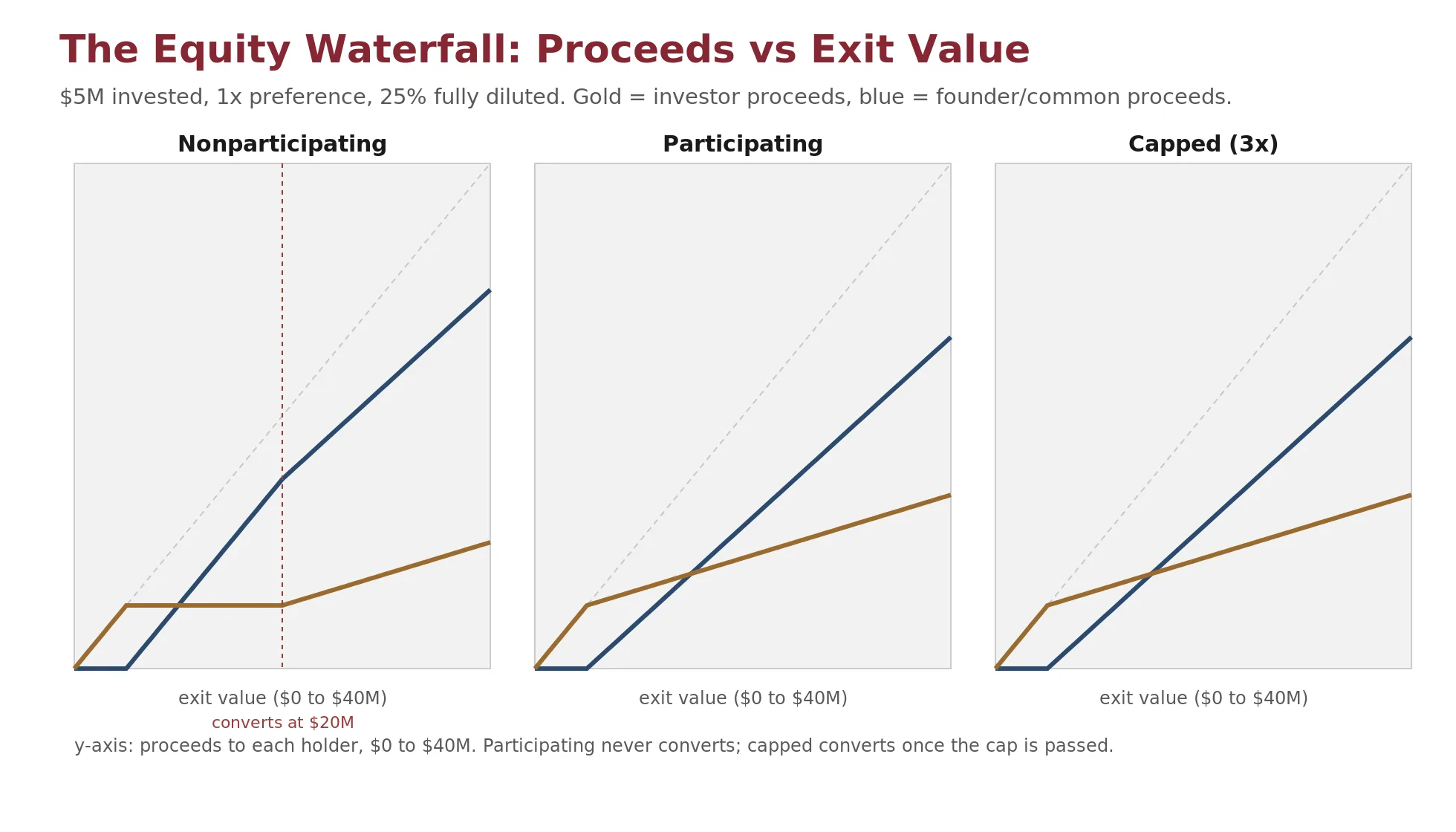
A cap table shows ownership percentages. A waterfall shows what those percentages are worth across a range of exit values. Because preferred stock has a liquidation preference, the payoff lines are not simple straight lines; they bend at the points where the preferred's behavior changes. The waterfall is the single most important tool for understanding the economic reality of a venture deal.
Three Shapes, One Diagram
Nonparticipating preferred has three segments. Below the preference, the preferred receives everything and common receives nothing. Between the preference and the conversion point, the preferred receives a flat amount equal to the preference while common receives everything above it. Above the conversion point, the preferred converts to common and everyone receives a pro rata share. The conversion point equals the preference divided by the preferred's fully diluted ownership.
Participating preferred has two segments in an acquisition. Below the preference, the preferred receives everything. Above it, the preferred receives its preference plus its pro rata share of the remainder. There is no conversion point, because for a plain participating preferred the preference plus a pro rata share is worth more than a pro rata share alone.
Capped participating adds a ceiling, commonly 2 to 4x, above which participation stops. This creates four segments: below the preference, participating, at the cap, and above the point where converting to common yields more than the cap.
Why the Waterfall Matters More Than the Cap Table
Consider $5M invested for 25% of fully diluted shares. At a $20M exit, founders receive $15M under nonparticipating preferred but $11.25M under participating. The cap table shows the same 75% common ownership in both cases; only the waterfall reveals the difference. At a $10M exit, founders receive $5M under nonparticipating but $3.75M under participating. These are not edge cases; they are the range of exits most venture-backed companies actually reach.
Check Your Understanding
Knowledge Check 12
Term Sheets & Liquidation Preferences
On a plain (uncapped) participating preferred, where the holder receives its liquidation preference and then also shares pro rata in the remaining proceeds, why does converting to common leave the investor worse off in an acquisition?
Dilution Compounds Across Rounds
Each financing round adds shares to the cap table and reduces the founders' ownership percentage. The dilution from a Series A interacts with the dilution from a Series B, and the combined effect is greater than either round considered alone, because each round is calculated on a fully diluted count that already includes every prior round.
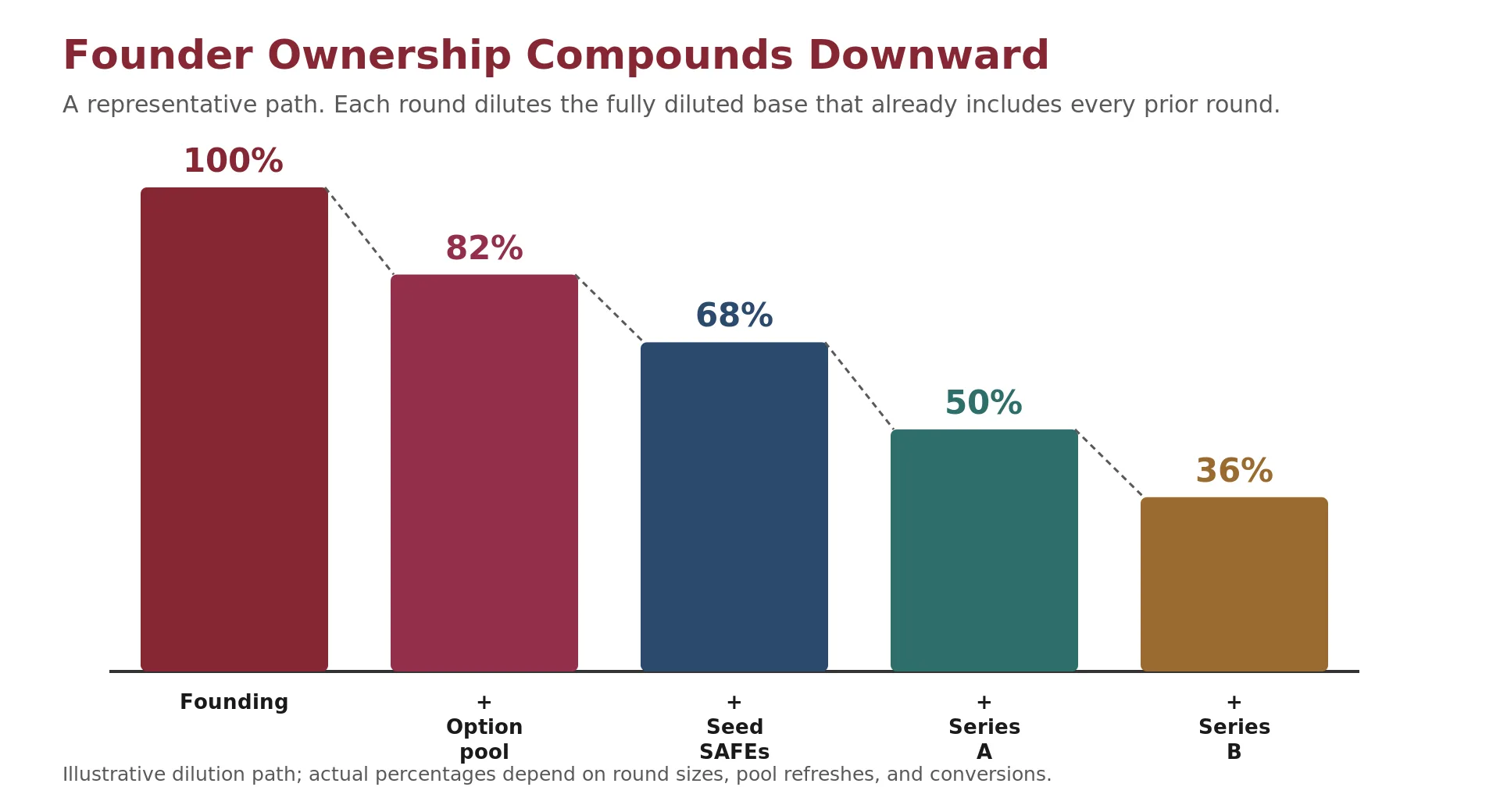
A representative path runs from 100% at founding, to about 82% after an option pool, to about 68% after seed SAFEs convert and the pool is refreshed, to about 50% after Series A, and to about 36% after Series B. The specific percentages depend on round sizes, pool refreshes, and how many convertibles are outstanding, but the shape is general. Ownership falls faster than a founder expects because the dilution is multiplicative, not additive.
The practical implication is to plan the full financing path, not one round at a time. A founder who optimizes the seed round in isolation may still reach Series B with far less ownership than intended, because each subsequent round compounds on the enlarged base.
Adjust the round sizes and option-pool refreshes to watch founder ownership compound downward across successive rounds. The defaults reproduce the representative path of 100% at founding to about 82%, 68%, 50%, and 36% after Series B.
Check Your Understanding
Knowledge Check 13
Cap Tables & Dilution
Why is founder dilution across several rounds greater than the sum of each round viewed alone?
Antidilution Redistributes Downside Risk to Founders
Antidilution protection modifies the ratio at which preferred stock converts to common in a down round, a financing priced below a prior round. The three forms differ in how harshly they shift value from the founders back to the earlier investor.
| Form | Mechanism | Founder impact |
|---|---|---|
| Broad-based weighted average | Adjusts the conversion price by the size of the down round relative to total capitalization | The most common and most founder-friendly form |
| Narrow-based weighted average | The same formula, but uses only the affected series' shares in the denominator | More dilutive to founders than broad-based |
| Full ratchet | Resets the conversion price to the new round's price regardless of round size | The most dilutive; one low-priced share triggers it |
Worked example. A Series A investor bought 2,000,000 shares at $5.00, investing $10M, and the company later prices a down round at $2.50. The antidilution form determines how many common-equivalent shares the Series A converts into.
- Full ratchet: the conversion price resets to $2.50, so the $10M investment now converts at $10M / $2.50 = 4,000,000 shares, double the original 2,000,000.
- Broad-based weighted average: the conversion price falls only modestly, to about $4.77, so the Series A converts into about 2,095,238 shares, a small increase.
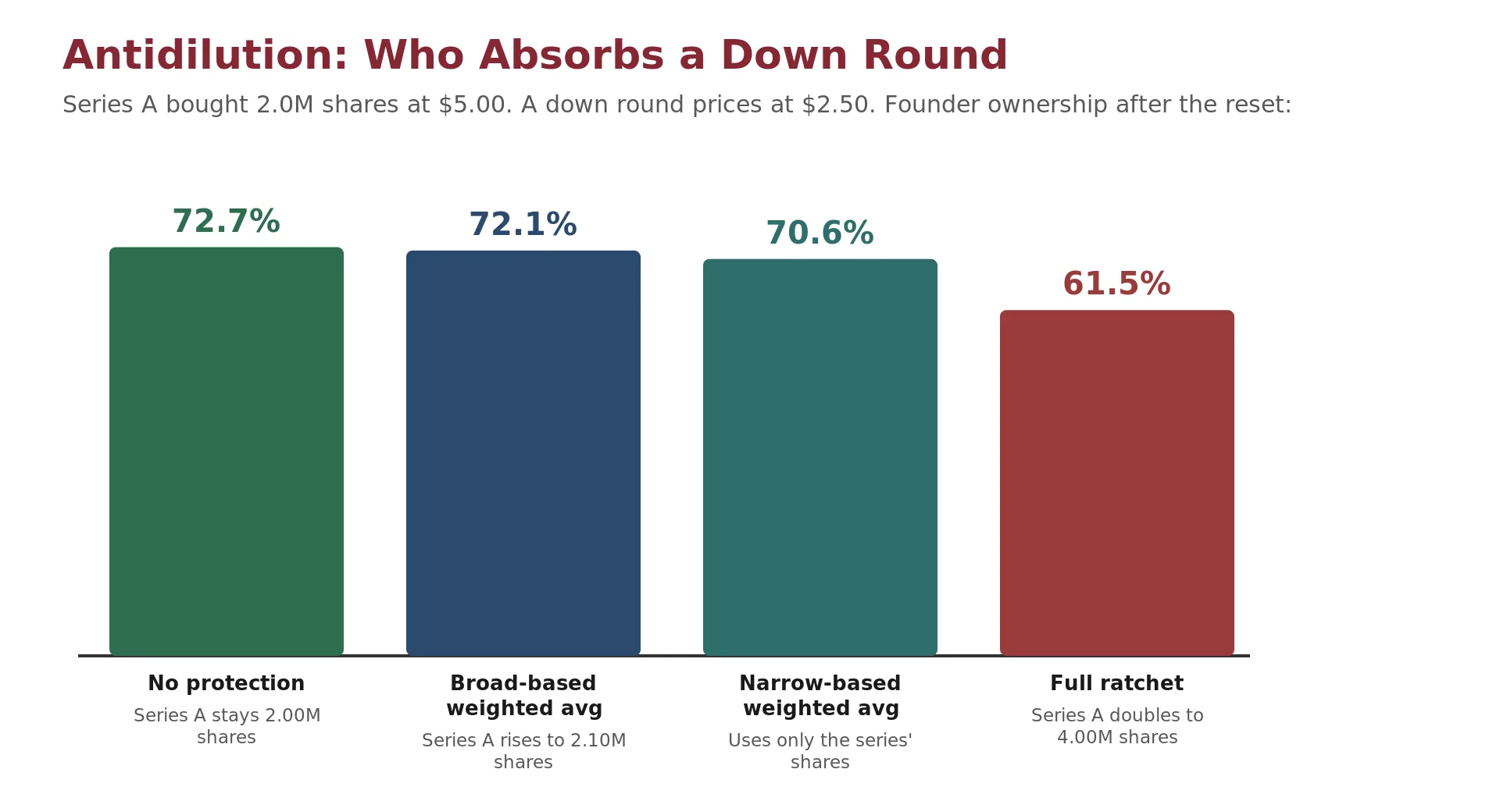
If the founders held 8,000,000 shares and the down round issued 1,000,000 new shares, founder ownership falls to about 61.5% under full ratchet but stays near 72.1% under broad-based weighted average. The lesson is to accept broad-based weighted average as the market standard and resist full ratchet, which ignores the size of the dilutive offering entirely.
Adjust the down-round price and share counts to see how each antidilution form shifts founder ownership. The defaults reproduce the worked example above.
Check Your Understanding
Knowledge Check 14
Antidilution & Protective Provisions
In a down round, how does full-ratchet antidilution treat the earlier investor's conversion price?
Knowledge Check 15
Antidilution & Protective Provisions
In a down round, why is broad-based weighted-average antidilution considered more founder-friendly than full ratchet?
Term Sheets Are Negotiated as a Package
Valuation gets the most attention in a term sheet, but it is not the term that most affects founder economics. Feld and Mendelson (2019) divide term-sheet provisions into two categories, economics terms and control terms, and both contain provisions that can alter the outcome as much as valuation does.
Economics Terms
- Liquidation preference multiple: push for 1x. A 2x preference on a $5M investment means $10M must be paid to investors before common receives anything.
- Participation: nonparticipating is the NVCA default and the most founder-friendly. Resist full participation, and negotiate a cap if participation is unavoidable.
- Cumulative dividends: these accrue whether or not the board declares them. At 8% a year they add $400K annually to the redemption value of a $5M investment. Prefer noncumulative dividends.
- Antidilution: accept broad-based weighted average, and reject full ratchet.
- Pay-to-play: requires existing investors to join a down round or lose preferred status. It protects founders by ensuring investors who supported the company in good times also support it in difficult rounds.
Control Terms
- Board composition: the lead investor takes a seat. A common early structure is founder seats, investor seats, and one independent seat, and founders should avoid losing board control too early.
- Protective provisions: these require approval for major decisions such as a sale, new stock issuance, or dividends. A supermajority threshold can give a single investor a veto.
- Drag-along rights: these require shareholders to vote for an approved sale, preventing a minority from blocking an exit.
- Pro rata rights: these let investors maintain ownership in future rounds. As Gompers and Lerner (2004) discuss, preserving ownership in the winners is central to venture fund returns, so investors value these rights highly.
Negotiate the term sheet as a package, not term by term. Investors and founders care about different terms, and trading concessions on low-priority items for wins on high-priority items is the most effective strategy. Ideally, negotiate with a pro forma cap table and a waterfall in front of you.
Vesting and the 83(b) Election
Vesting prevents a founder or employee from leaving with a full equity stake after a brief contribution. Founder shares commonly vest over three to four years with a one-year cliff. Single-trigger acceleration vests all shares on an acquisition, while double-trigger acceleration requires both an acquisition and a termination without cause, which makes it a retention tool for the acquirer.
The Section 83(b) election is the most consequential tax decision a founder makes at incorporation. Restricted stock is ordinarily taxed as compensation as each tranche vests, at the fair market value at that time. Filing an 83(b) election within 30 days of the grant elects to be taxed at grant instead, when the value is near zero, so all later appreciation is taxed as capital gain. Missing the 30-day window is irreversible.
Check Your Understanding
Knowledge Check 16
Cap Tables & Dilution
A founder receives restricted stock at incorporation when its value is near zero. What does filing a Section 83(b) election within 30 days of the grant accomplish?
Limits of This Module
This module explains the mechanics of equity structures, not legal or tax advice. Cap tables, term sheets, and elections such as 83(b) and QSBS carry consequences that depend on the specific facts and on current law, and founders should engage qualified counsel before acting.
The worked examples use clean, rounded inputs to isolate one mechanic at a time. Real financings combine option pool refreshes, converting instruments, and multiple preferred series at once, and the interactions can move ownership by several percentage points beyond what a single example shows.
Market conventions change. Instrument prevalence, standard preference multiples, and pool sizes reflect the current venture market, and the figures cited are dated to their sources rather than presented as permanent norms.
The tax figures, including the 2025 QSBS holding-period schedule, are stated as of mid-2025 law and are subject to change and to facts specific to each holder.