
Module 1CHAPTER 01
Accounting and Financial Statement Preparation
From scattered records to a reviewable financial reporting package. Why growing businesses so often lack reliable financial statements and what weak records cost them; what a controller builds and why it is expensive; where agentic AI genuinely helps with unstructured records and where professional judgment still rules; and the full walkthrough: benchmarking comparable companies, assembling the records and the business-background memorandum, running the preparation workflow with an agentic model, and reviewing the Word, PDF, and Excel package it produces. Ends with the review rule that no AI-generated statement skips a qualified professional, and a personal-finance variant you can try on your own records.
~120 min7 sections29 questions5 tools
Learning objectives (8)
Learning Objectives
By the end of this chapter you should be able to:
- 1Diagnose why financial activity at a growing business tends to scatter across bank accounts, credit cards, customer contracts, payroll systems, tax filings, cap tables, and informal spreadsheets, and identify the external events that typically force serious attention to accounting.
- 2Evaluate the founder's capital-allocation tradeoff between a traditional controller-led finance function, whose total cost can easily reach hundreds of thousands of dollars each year, and the costs that weak financial records impose on financing, tax filings, investor confidence, and decision-making.
- 3Distinguish the structured-data work traditional accounting systems handle well from the unstructured-source work where agentic AI adds value, and describe the human-in-the-loop division of labor that keeps judgment areas such as revenue recognition, equity classification, tax elections, capitalization, and related-party transactions with qualified professionals.
- 4Apply the MAP framework to a financial statement preparation project by answering where the company is now, where it is trying to go, and how it gets there, including benchmarking approximately three comparable companies with publicly available financial statements.
- 5Compose a business-background memorandum that supplies the context transaction descriptions alone cannot, covering history, ownership, business model, revenue sources, compensation and financing arrangements, accounting policies, and known issues, and verify the source folder is complete before any prompting.
- 6Run the AI-assisted preparation workflow: select the strongest reasoning model available within the approved technology environment for the initial pass, review the model's proposed plan and progress during a run that may take anywhere from 5 to 30 minutes, and interpret the three-file output package.
- 7Direct an enhancement pass on the Excel model that emphasizes auditability and traceability over appearance, including standardized color coding, tracing each material balance to the trial balance, supporting schedule, and original source document, and labeling all assumptions, judgments, and estimates.
- 8Assess an AI-prepared reporting package the way a professional reviewer would, applying the rule that a qualified accountant or tax professional reviews the output before tax filings, audits, lending, or investor reporting, and weighing privacy, security, and data-retention cautions before uploading any financial data.
Part One: Why Growing Businesses Lack Reliable Financial Statements. Section 1 of 7.
Part One · Why Growing Businesses Lack Reliable Financial Statements
Why Growing Businesses Lack Reliable Financial Statements
Part One
Why Growing Businesses Lack Reliable Financial Statements
A growing business can win customers, raise money, and build a real product long before it can produce a reliable set of financial statements. This part examines why that gap opens: where a founder's attention goes in the early years, which external events finally force accounting onto the agenda, and why reconstructing years of scattered records turns out to be far harder than any single transaction suggests.
Why this module begins with financial statements
Reliable accounting information is the foundation for nearly everything else a business does with its numbers. Forecasts, valuations, investor communications, and day-to-day decisions all rest on the same base: an accurate record of what the company has actually earned, spent, owed, and owned. That is why this module starts with one of the earliest operational challenges facing a growing business, creating reliable financial statements.
The instructor's perspective on this problem comes from hands-on work. Over the past year he has trained teams at RealPage, PagerDuty, and KAIST University, along with many other companies and firms, on practical AI use cases, and he explores these topics regularly through the GAAPSavvy podcast with Angela Liu. From those trainings he groups the most important business applications of AI into three broad areas: accounting and financial analysis; goal setting, forecasting, and valuation; and managing the path from the current state to future goals, including risk, diversification, and decision-making under uncertainty. In his experience, these tools can improve both efficiency and quality, potentially by 10 times, without replacing professional judgment. The claim is deliberately conditional. The improvement depends on applying the tools to well-chosen problems, and financial statement preparation is among the best-suited of them.
Where a founder's attention goes, and what interrupts it
Founders may understand their products, customers, and markets exceptionally well while having limited experience with accounting systems, financial reporting, or tax compliance. This is understandable. During the early stages of a company, management is usually focused on developing the product, winning customers, hiring employees, and preserving cash. Accounting does not directly generate revenue, so it tends to wait.
Accounting often receives serious attention only when an external event makes it unavoidable:
- A tax return becomes due.
- An investor requests financial statements.
- A lender asks for historical results.
- A prospective buyer begins due diligence.
By that point, years of financial activity may be scattered across bank accounts, credit cards, customer contracts, payroll systems, tax filings, cap tables, and informal spreadsheets. Each of those sources is legitimate on its own; the trouble is that no one of them tells the whole story. Reconstructing the economic history of the business from all of them and converting it into a coherent financial reporting system can be difficult and expensive.
Why the reconstruction is hard: facts, not arithmetic
The difficulty is not the math. A bank statement may show a $100,000 customer payment, but it does not reveal whether the amount represents revenue already earned, an advance payment for future services, reimbursement of expenses, or repayment of a loan. The accounting treatment depends on the underlying facts, and those facts live in contracts, emails, and the founder's memory rather than in the transaction description.
The same fact-dependence runs through the whole reconstruction. The company may need to determine whether customer payments represent revenue, deposits, or deferred revenue. It may need to identify unpaid obligations, separate business expenses from owner activity, account for equipment and software costs, reconcile equity issuances, and document arrangements with employees, contractors, lenders, and investors. Each transaction may be understandable on its own. Organizing thousands of transactions into a complete and consistent set of financial statements is much harder, because every classification decision multiplies across the ledger and inconsistencies compound.
This challenge becomes especially acute when a company succeeds before it develops a mature finance function. Success accelerates the volume of transactions, contracts, and equity activity at exactly the moment no one is assigned to keep them organized. The next part turns to the traditional answer to this problem, hiring an experienced controller, and to the capital-allocation tension that answer creates for an early-stage company.
Check Your Understanding
Knowledge Check 1
Financial Statement Prep
A startup's bank statement shows a single $250,000 incoming wire from its largest customer. Based on the bank statement alone, what can the company conclude about the accounting treatment of this payment?
Part Two
The Controller Model, Its Cost, and the Agentic Opening
The traditional answer to messy financial records is to hire an experienced controller, and that answer works. It is also expensive, and the expense creates a capital-allocation tension that many early-stage companies resolve by deferring accounting altogether. Agentic AI opens a third path: it can perform much of the document-intensive work a controller would otherwise do by hand, provided a qualified professional stays in the loop for the judgment calls.
What a capable controller builds
A company that raises institutional capital or reaches a meaningful level of operating complexity will often hire an experienced accountant, controller, or finance leader. The title matters less than the mandate: this person is responsible for much more than recording transactions. A capable controller develops the financial infrastructure of the organization. That infrastructure includes establishing a chart of accounts, selecting accounting systems, creating monthly close procedures, reviewing contracts, documenting accounting policies, reconciling balance sheet accounts, implementing internal controls, and preparing reports for management and external stakeholders.
Each of those items is a system rather than a one-time task. A chart of accounts shapes how every future transaction is classified. Close procedures determine whether the books are reliable month after month, not just once. Reconciliations and internal controls are what keep the ledger anchored to reality as volume grows. Reporting is the visible output, but it rests on everything underneath it.
This work is essential, and it is also expensive. An experienced controller may require a substantial salary, employee benefits, accounting software, and support from external tax, audit, or advisory firms. For an early-stage company, the total cost can easily reach hundreds of thousands of dollars each year.
The capital-allocation tension and the price of weak records
Founders therefore face a legitimate capital-allocation problem. Every dollar spent on accounting is a dollar that cannot be invested in product development, customer acquisition, or additional employees. Because accounting does not directly generate revenue, it is frequently viewed as an administrative burden to be minimized. That reasoning is understandable, and for a company fighting to survive it can even look prudent.
It can also become costly. Weak financial records can delay a financing round, complicate tax filings, reduce investor confidence, and increase the cost of an audit or transaction. Those are the external prices. The internal price may be worse: management can end up making decisions using incomplete or misleading information. A business may appear profitable while consuming cash, or it may appear financially weak because revenue, expenses, or assets have been recorded incorrectly. Either error points management in the wrong direction at exactly the moments when direction matters most.
The agentic opening: structured systems, unstructured sources
Recent advances in agentic AI create a new approach to this problem. Traditional accounting systems are effective when information has already been structured correctly: they can record journal entries, maintain ledgers, and produce reports. Their limitation is that much of the information required for accounting begins in an unstructured form. A customer contract may be stored as a PDF. A founder contribution may appear only as a bank transfer. A software subscription may appear on a credit card statement with an abbreviated merchant name. An equity arrangement may be described in legal documents but not reflected correctly in the accounting records.
Connecting those sources is exactly the work agentic AI can assist with. It can extract information from documents, classify transactions, summarize contracts, identify inconsistencies, create supporting schedules, and draft preliminary financial statements. It can also maintain a record of unresolved questions and identify areas requiring professional judgment. That list covers a large share of the assembly work that would otherwise consume a controller's hours.
What it cannot do is independently determine the correct accounting for every transaction. Financial reporting often depends on facts that are incomplete, ambiguous, or highly specific to the company. Revenue recognition, equity classification, tax elections, capitalization, and related-party transactions may require experienced professional judgment, and a model working from documents alone lacks the facts and the authority to settle them.
The more realistic opportunity is a human-in-the-loop model. AI performs much of the document-intensive and organizational work, while qualified professionals review the results, resolve judgmental issues, and approve the final reporting. This division reduces the time the accountant must spend locating documents, entering data, rebuilding schedules, and identifying missing information, while improving the overall quality and accuracy of the work. The parts that follow turn this model into a concrete procedure, beginning with a simple planning structure for the whole project.
Check Your Understanding
Knowledge Check 1
Financial Statement Prep
A startup is using an agentic AI workflow to rebuild two years of financial records. Under a human-in-the-loop model for AI-assisted financial statement preparation, which of the following tasks should remain with a qualified professional rather than be settled by the AI on its own?
Part Three
MAP, Step One: Where Are You Trying to Go
The MAP framework organizes financial statement preparation as a journey to map out, built on three questions: where are you now, where are you trying to go, and how do you get there. The walkthrough begins with the destination, because a company that can point to concrete examples of the reporting package it wants has a target the later steps can aim at. The first working session is therefore a search for comparable companies whose published financial statements can serve as benchmarks.
Three questions that structure the project
A company that has decided to build reliable financial statements faces a project with many moving parts: records scattered across accounts and systems, an output no one has defined, and no obvious sequence of steps. The MAP framework brings order to this kind of project by treating the process as a journey to map out. It asks three questions. Where are you now? Where are you trying to go? How do you get there?
These questions provide a simple structure for a complicated project. Before preparing financial statements, the company must understand the information it currently has, define the reporting package it needs, and design a process for moving from one state to the other. Each question maps to one of those tasks, and the walkthrough in this module takes them up in turn.
The destination comes first in the working order. A defined target, in the form of real financial statements the company would be proud to produce, gives the inventory of current records and the design of the preparation process something concrete to aim at. This part covers that first step.
The pattern for this module
The workflow this module walks through is drawn below as a pattern, and it follows the three MAP questions end to end. The scattered records are the starting point. An AI step benchmarks the destination. A human step curates the folder and writes the background memorandum. A second AI step drafts the statements under a plan you review before it runs. A professional-style review then stands between the draft and anything you would show a lender. Open each step to see the prompt it uses and the ways it tends to go wrong before you run it yourself in the lab later in this module.
Ask for comparable companies before you build anything
Begin by asking AI to identify comparable companies with publicly available financial statements. The published statements of similar businesses show what a complete reporting package looks like for a company of your size and model, before you have drafted a single schedule of your own. The source case uses a small consulting firm, and the prompt below is the one the instructor used.
Deep-research functionality is generally preferable for this task because the model can investigate multiple sources, compare business models, and document its reasoning. Standard web search can also be effective for a simpler analysis. The documented reasoning matters as much as the list of names, since you will want to judge for yourself whether each suggested company is genuinely comparable.
Exact matches may not exist, and that is acceptable. The objective is to identify useful reference points for:
- Financial statement structure
- Revenue presentation
- Expense classifications
- Accounting policy disclosures
- Risk disclosures
- Management reporting practices
Once you have identified the strongest benchmarks, select approximately three companies and download their financial statements or annual reports as PDF files. Save them in the project folder that will contain the company's financial records, so the benchmarks travel with the engagement and remain available to every later step of the workflow.
When the instructor ran this prompt through GPT 5.6 Sol, the model returned the results shown below: a set of candidate companies with public financial disclosures, each accompanied by an explanation of why it is comparable and a note identifying where its financial information is published.
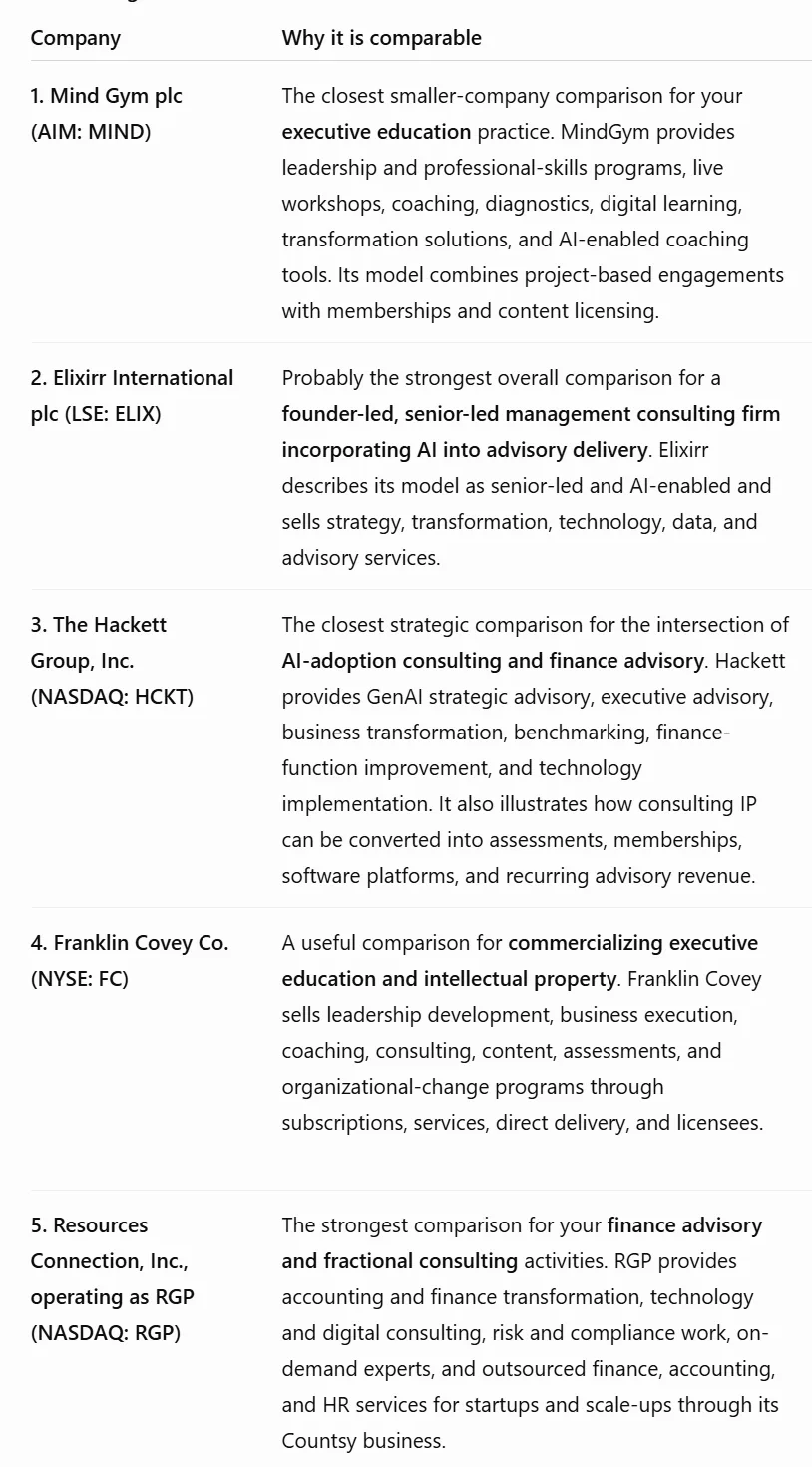
With roughly three benchmark filings saved in the project folder, the destination question has a working answer. The next step in the MAP framework turns to the other end of the journey: taking inventory of the information the company already has.
Check Your Understanding
Knowledge Check 1
Financial Statement Prep
The founder of a small logistics startup runs a deep-research query for companies with similar business models and publicly available financial statements. Every result is larger than her business and none matches it exactly. Under the MAP framework's destination step, what is the most appropriate way to use these results?
Part Four
MAP, Step Two: Where Are You Now
With the destination defined by the benchmark statements, the second MAP question turns inward: what information does the company actually have? Answering it means assembling every record of the company's financial life into one place and pairing those documents with a written account of the business itself. The quality of everything the AI produces later depends on how completely this step is done.
Assembling the records and the business-background memorandum
The next step is to assemble the company's existing information. For a small business, the relevant records will commonly include bank statements, credit card statements, customer contracts, invoices, payroll reports, contractor payments, formation documents, tax filings, debt agreements, and ownership records. Any existing accounting files belong in the collection as well, even if they are incomplete or inconsistent; a partial ledger still tells the model what the company has attempted to record and where the gaps sit.
Documents alone are not enough. A short business-background memorandum should accompany them to give the AI sufficient context to interpret what it reads. The memorandum should describe the company's history, ownership, leadership, business model, products and services, sources of revenue, major customers and vendors, employee and contractor compensation arrangements, financing structure, accounting policies, operational systems, and any unusual or significant transactions. It should also explain the founder's relevant background, the company's current stage of development, its primary business objectives, and any known accounting, tax, legal, or financial reporting issues that may affect the analysis.
That list is long because the memorandum is doing the work a controller would otherwise do through months of familiarity with the business. When you write yours, treat it as the one document that lets a stranger, human or machine, read the rest of the folder correctly.
Why context decides the accounting, and how to check for completeness
Accounting cannot be determined from transaction descriptions alone. A bank statement may show a $100,000 customer payment, but it does not reveal whether the amount represents revenue already earned, an advance payment for future services, reimbursement of expenses, or repayment of a loan. Each of those readings produces a different balance sheet and a different income statement from the same bank line. A legal invoice raises the same problem: it may relate to ordinary operations, a financing transaction, or the formation of the company, and each purpose carries a different treatment. The accounting depends on the underlying facts, and the memorandum is where those facts live.
Context solves interpretation; it does not solve omission. The company should also determine whether the source information is complete. All relevant bank and credit card accounts should be included. The reporting period should be fully covered. Beginning and ending balances should be available. Material contracts, financing arrangements, and equity transactions should be identified. AI can organize the information it receives, but it cannot reliably account for records that were never provided, so a missing account produces a quiet gap in the statements rather than an error message.
Once you complete the organization of this information, the project folder holds the company's documentary record alongside the narrative that explains it.
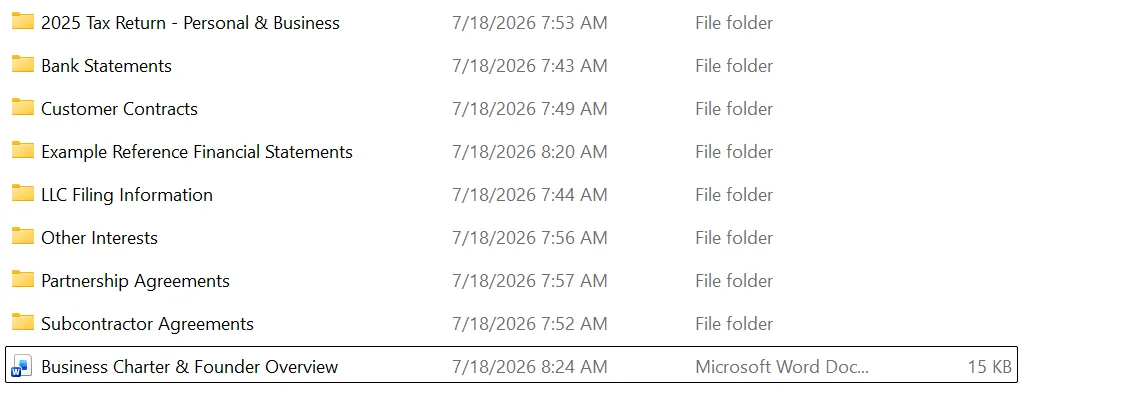
This folder is the answer to "where are you now." The next MAP question, how to get from these records to the reporting package defined earlier, is where the AI-assisted preparation itself begins.
The red-lines check for financial records
The folder you just assembled is about to be handed to an AI tool, and that makes this the moment for the red-lines check. Bank statements, card statements, and payroll reports are among the most sensitive records a business holds: they name people, pay, and counterparties. Before any upload, confirm the instance is approved for that data class, review the provider's privacy, security, and data-retention policies, keep the folder scoped to what the statements need, and make sure the output still ends with a qualified professional. The lab in the next part uses a fully synthetic company, so its records are cleared for any tool, but the habit of running this check first is exactly what you are practicing.
Check Your Understanding
Knowledge Check 1
Financial Statement Prep
A founder uploads two years of bank statements to an AI workflow. One statement line shows a $60,000 wire received from a customer. Based on the bank record alone, what can be concluded about the correct accounting treatment?
Part Five
MAP, Step Three: How Do You Get There
The first two MAP questions produced a defined destination and an organized folder of source records. The third question turns that preparation into output. Once the company has defined the desired reporting package and assembled the available information, it can begin the AI-assisted preparation process: point a strong agentic model at the folder, confirm the right skill, submit a detailed prompt, and supervise the run while it works.
Pointing the model at the records
The run begins with orientation, not with a request for financial statements. For this workflow, the instructor used Claude's Fable model. Within Claude, the first move was to direct the model to the folder containing all relevant information, then to confirm that the appropriate skill was enabled, and then to explain three things in plain language: how the folder is organized, which documents it contains, and what outputs the run should produce.
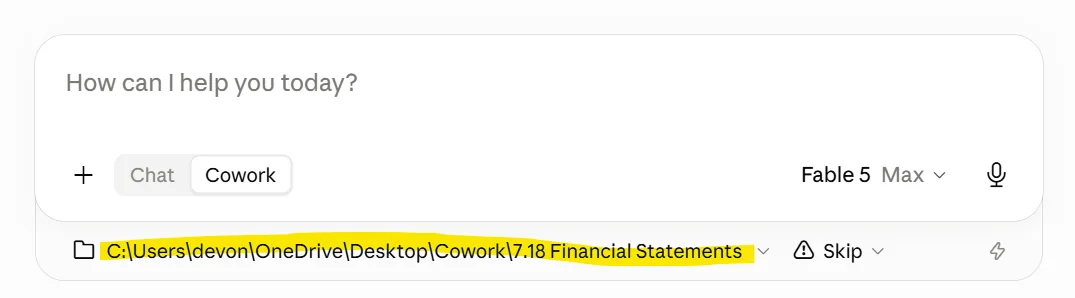
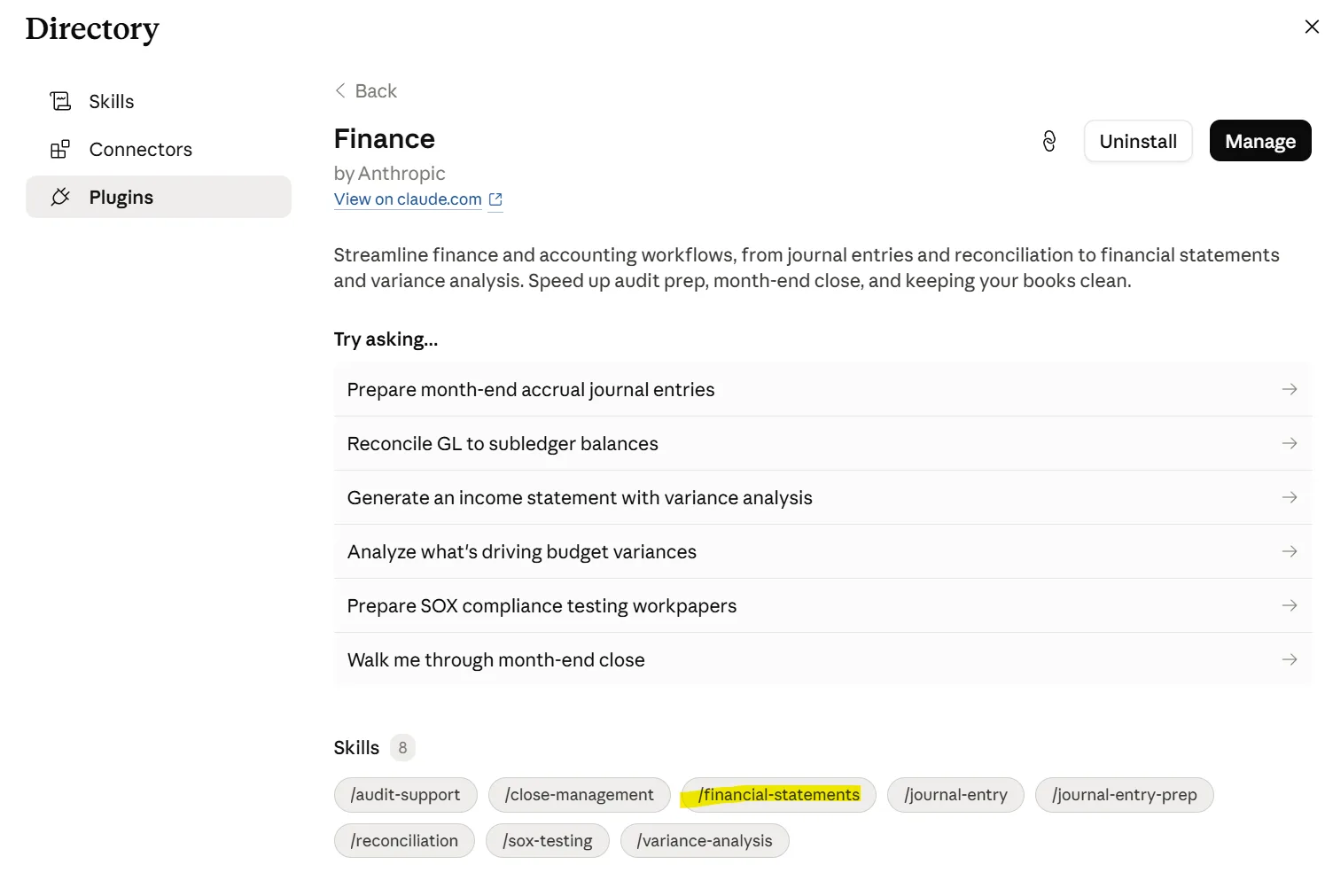
That explanation earns its keep later in the run. A model that knows where the bank statements end and the contracts begin can connect information across sources instead of guessing at what each file represents. The skill supplies the workflow's accounting scaffolding. For this exercise, the instructor used the Finance plugin and selected the "Financial Statements" skill within it.
The prompt and the choice of model
With the folder connected and the skill selected, the next step is the prompt itself. The instructor's full prompt is long enough that it is provided as a separate document rather than reproduced here: you can find it in the resources for this module as a linked Google Doc, and you are welcome to review it and adapt it for your own workflow.
Model selection matters as much as prompt wording. For work of this complexity, companies should generally use the strongest reasoning model available within their approved technology environment. The reasoning demand is real: the model must review multiple documents, connect information across sources, perform calculations, and distinguish routine classifications from areas requiring accounting judgment. A lighter model saves money on the run and can give that saving back in cleanup.
The proposed plan, the runtime, and supervision
Submitting the prompt does not immediately produce financial statements. The model first responds with a proposed plan outlining how it intends to approach the work, and that plan is the first checkpoint for the human in the loop.
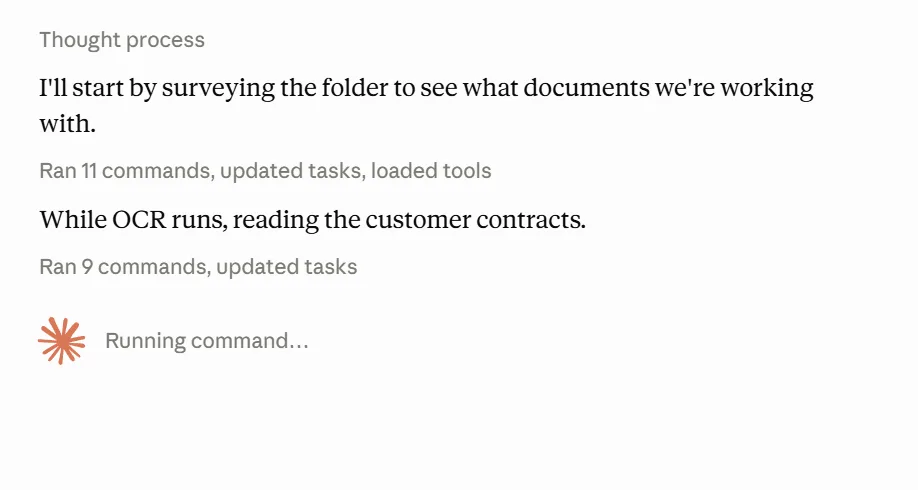
At the time of writing, a workflow of this complexity may take anywhere from 5 to 30 minutes. That runtime is not dead time. While the run proceeds, you can begin other workflows or continue working in separate conversations, which is part of what makes the agentic pattern productive: the model works through the records while you work on something else.
Supervision continues during the run. You can periodically review the model's plan and progress as it moves through the documents, and that review is where problems get caught early rather than after twenty minutes of misdirected work. In the instructor's case, the proposed plan aligned with the instructions given, so he was comfortable allowing the process to continue.
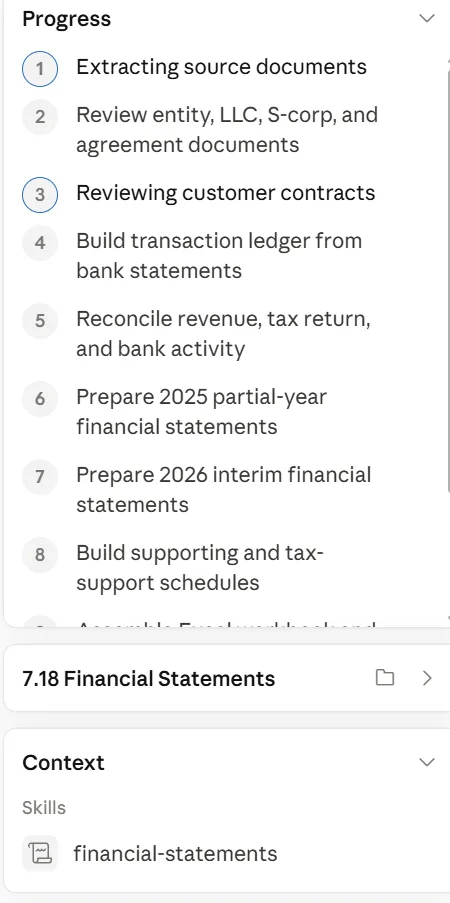
The pattern across this step is consistent: the model does the document-intensive work, and the human sets the direction and checks the course. The next part examines what the run actually delivered and how the output held up under a CPA's review.
The lab: run the workflow yourself
Now run the same workflow on a company built for practice. The folder below holds one quarter of scattered records for Meridian Advisory Services, LLC, a small fictional consulting firm: three monthly bank statements, a credit card statement, a payroll summary, a lease, a retainer agreement, and a background-memorandum template to fill in first. Your job is to produce three monthly cash-basis income statements and a simple balance summary with your own AI, ask for the model's plan before it drafts, and make every total tie to the records. The company and every number are fictional, so the folder is cleared for any tool.
Check Your Understanding
Knowledge Check 1
Financial Statement Prep
A startup is about to run an AI-assisted financial statement preparation workflow for the first time, and its team is debating which model tier to use. Which approach matches the guidance for a first run of this workflow?
Part Six
The Output: A Reviewable Reporting Package
The workflow ends with deliverables, not a chat transcript: a Word statement package, a PDF version, and an Excel model that carries the schedules and tie-outs behind every number. The instructor's review of that output as a CPA sets the standard for how to read it, and a final pass with AI inside Excel shows how to push the workbook toward the property that matters most to a reviewer, auditability.
Three files, one reporting package
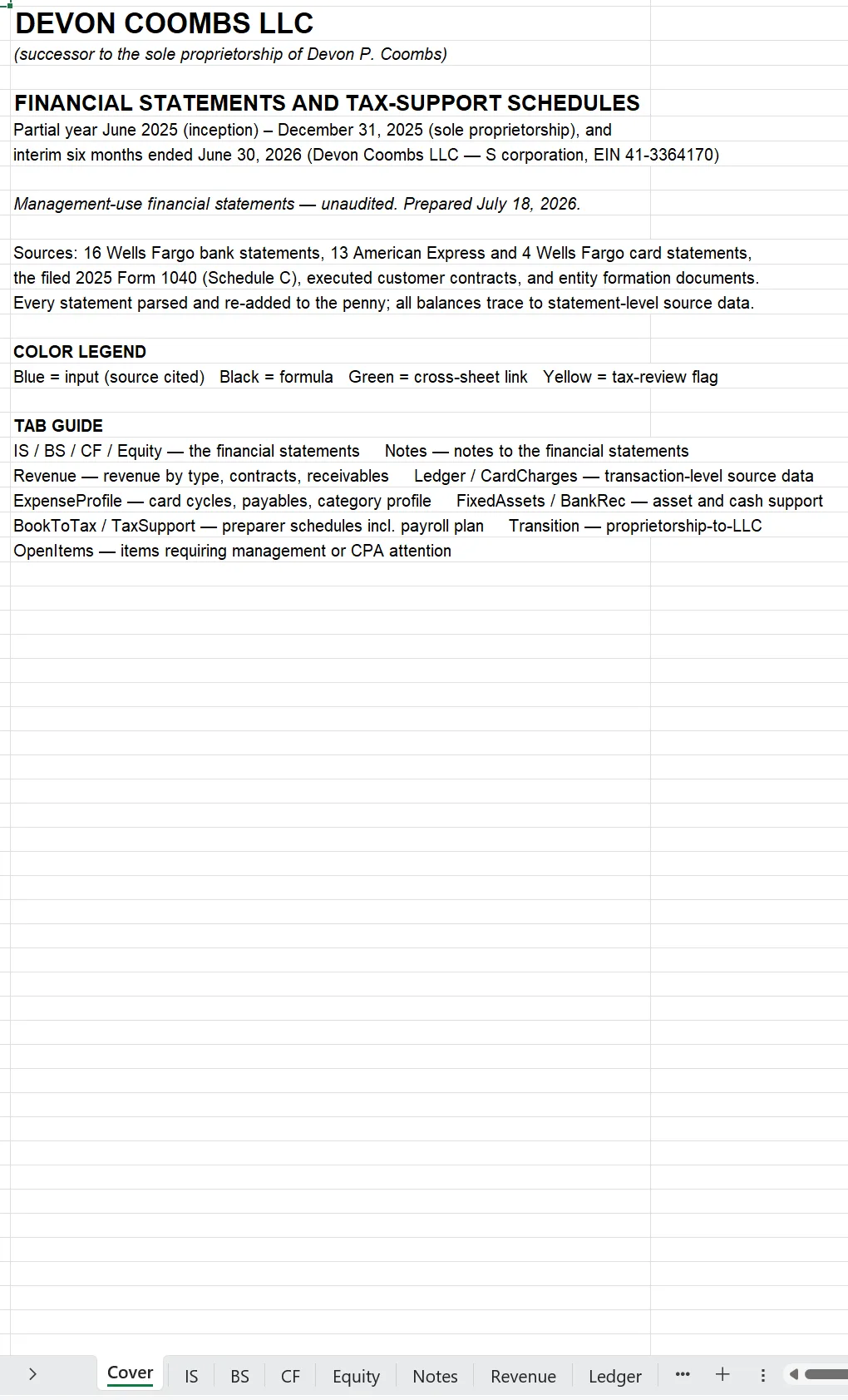
When the workflow finished, the instructor received three files: a Word financial statement package, a PDF version of the financial statements, and an Excel model containing the supporting schedules, formulas, and financial statement tie-outs. The three formats serve different readers. The Word and PDF documents present the statements in the form an investor, lender, or tax preparer expects to receive, while the Excel model holds the machinery, the place where a reviewer can see how each reported balance was built.
The Excel model included the balance sheet, the income statement, the statement of cash flows, the statement of equity, revenue tie-outs, supporting schedules, and notes to the financial statements. Each statement therefore sits next to the detail that supports it, so a figure on the face of the balance sheet can be followed into a schedule rather than taken on faith.
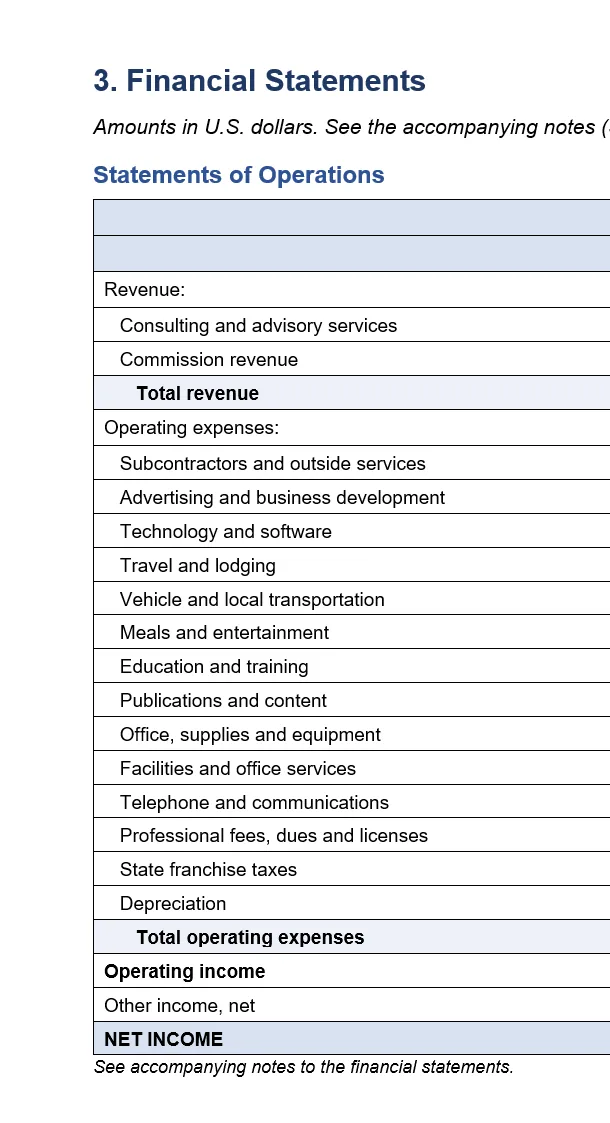
The Word package presents the statements themselves. An example of the income statement produced within the package appears below, formatted as a finished statement rather than a raw data export.
The CPA review: a strong starting point, not a finished product
A package that looks complete still has to survive professional review, and the instructor reviewed this one in his capacity as a CPA. His verdict: the output was materially accurate and provided a strong starting point. Some additional judgment and adjustments were still required to finalize the numbers, and the footnotes needed further refinement.
The structural qualities held up better than the edges. The underlying detail was well organized, the supporting information was tied to the financial statements, and the source documents were referenced and attached. In his assessment, with several additional review passes and the application of professional judgment, the package could get surprisingly close to being ready for a first-year audit.
Enhancing the workbook: auditability over appearance
Once the underlying accounting has been reviewed, AI can also improve the structure and presentation of the financial workbook. Using ChatGPT or Claude within Excel, you can prompt the AI to standardize formatting and color schemes, verify that reconciliations are complete, and review the information contained in the underlying schedules and tables.
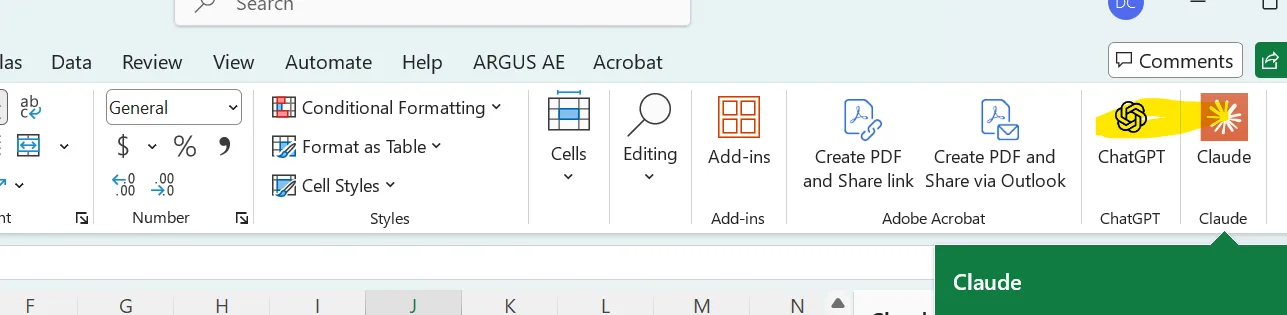
In the instructor's case, this pass turned out to be lighter than expected. When he reviewed his workbook, most of this work had already been completed by the Fable model on its maximum setting, and the workbook required few, if any, additional updates. Lower-tier models may require more cleanup, but he reported being pleasantly surprised by the model's accuracy, completeness, and formatting.
Whether the pass is light or heavy, the prompt should ask for the same things. Useful instructions to include are:
- Apply standardized color coding to distinguish linked cells, formulas, and hardcoded values.
- Trace each material financial statement balance to the trial balance, supporting schedule, and original source document.
- Clearly label all assumptions, judgments, and estimates.
- Document any changes made to the model.
- Confirm that all financial statements and supporting schedules reconcile.
AI can assist with each of these tasks, but the instructions should emphasize auditability and traceability rather than appearance alone. A workbook that looks polished is not sufficient if a reviewer cannot understand where the numbers came from or how they were calculated. Every instruction on the list serves that test: color coding reveals what is linked and what is typed, tracing connects each balance to its evidence, and labeled assumptions show a reviewer where judgment entered the model.
Work the validation checklist
The same auditability standard applies to your own lab output, and the checklist below is how you hold it to that standard. The lab data ties internally to the dollar: payroll debits in the bank match the payroll summary, rent matches the lease, each monthly card payment equals that month's card charges, and ending cash equals the closing balance. So any figure in your statements that does not trace to a source transaction was introduced by the drafting, not the data. Work every item against your statements before you would consider the package done, and hold the judgment items, such as the owner draws, to a human decision rather than the model's.
Check Your Understanding
Knowledge Check 1
Financial Statement Prep
A founder asks AI inside Excel to clean up an AI-drafted financial workbook before sending it to an outside accountant. Which instruction does the most to make the workbook auditable, rather than merely better looking?
Part Seven
Judgment, Value, and Where This Goes Next
The workflow ends with a deliverable, and the deliverable deserves a sober appraisal: what the finished package actually contained, the review rule that governs how it may be used, and why a stronger starting point, rather than finished statements, is the honest description of the value created. The same logic extends to a personal-finance variant of the exercise, and it points directly at the topics this course takes up next.
What the finished package contained
A preparation workflow is judged by what it hands the reviewer, so the contents of the final package matter more than the speed of its assembly. At the end of the process, the instructor received a well-organized and surprisingly complete financial reporting package. The source documents were stored in a logical structure. The company's activities and accounting assumptions were documented in writing rather than implied. Material balances were supported by schedules and reconciliations, so a reviewer could trace a figure on the face of the statements back to the detail behind it.
The package also contained something a set of statements alone would not: a record of what remained unsettled. The model identified open questions for the instructor to discuss with his tax accountant. In his case, those issues were already on his radar, so the list served as confirmation rather than discovery. For a company that has not yet engaged an accountant, that same list would be especially valuable, because it converts unknown exposure into a named agenda for the first professional conversation.
The review rule, and the value measured honestly
One rule governs everything that follows from this workflow. The final output should still be reviewed by a qualified accountant or tax professional before it is used for tax filings, audits, lending, investor reporting, or other formal purposes. AI-generated financial statements should not be treated as authoritative simply because they look polished. A clean layout and tidy tie-outs signal effort, not correctness, and the formal uses listed above are exactly the settings where an undetected error carries real cost.
Even with that limitation, the process easily saved the instructor a week of work on his own financial information. That saving is his reported experience with one company's records, not a promised result, but it illustrates where the value sits. The technology creates a much stronger starting point. Instead of handing an accountant a disorganized collection of bank statements, contracts, and spreadsheets, a company can provide a structured package containing preliminary financial statements, supporting schedules, documented assumptions, source references, and a clear list of unresolved issues. This can reduce professional fees, shorten reporting timelines, and allow accountants to focus on the areas where their expertise adds the most value.
The earlier arrival of reliable information may matter even more than the fee savings. Management gains access to dependable financial information sooner in the life of the company, and that information can be used to manage cash, evaluate profitability, forecast performance, raise capital, and make better business decisions. The broader lesson is that AI is not valuable simply because it can produce financial statements. It is valuable because it can help transform fragmented records into a financial system that management can understand and use.
Check Your Understanding
Knowledge Check 1
Financial Statement Prep
A founder uses an AI workflow to produce a polished financial statement package, complete with tie-outs and schedules, and wants to send it directly to a bank that requested historical results for a loan decision. Under the review rule for AI-prepared financial statements, what should happen first?
A personal-finance variant, a privacy caution, and the road ahead
For the live course, the instructor is developing a set of dummy financial data that students can use to test this workflow, and he plans to share it once it is complete. There is also a more immediate option. People can test the process using their own personal financial information, which may be even more useful than practice data. Depending on the platform, account type, and privacy settings, you could upload your own bank statements, investment reports, and credit card statements to analyze your spending, assets, liabilities, and cash flow. You may identify subscriptions to cancel, unusual charges to investigate, or broader trends in your personal finances that are difficult to see across separate accounts.
That option carries a responsibility that comes before any upload. Carefully review the provider's privacy, security, and data-retention policies. Use appropriate privacy settings or an approved enterprise environment, and avoid uploading sensitive information to unsecured or untrusted platforms. You are responsible for determining whether a tool is appropriate for your personal or company data. The convenience of the analysis does not change who owns that decision.
Reliable statements are the foundation, and the course now builds on them. Module 2, Close and Reporting Acceleration, covers flux analysis and the accelerated-close workflow, the work of explaining what moved and why once the numbers are settled. Module 4 turns outward to benchmarking, peer analysis, and using financial statements to support market research and business decision-making. Each of those topics assumes what this module produced: financial information organized well enough to be interrogated.
Score your work
Before you move on, rate your lab package against the rubric below. Scored honestly, it shows where your preparation workflow is already solid, from the MAP design and the safe handling of financial records through the ties and the framing for review, and where it still needs reps. Your scores roll up to the workflow maturity dashboard on the course hub.